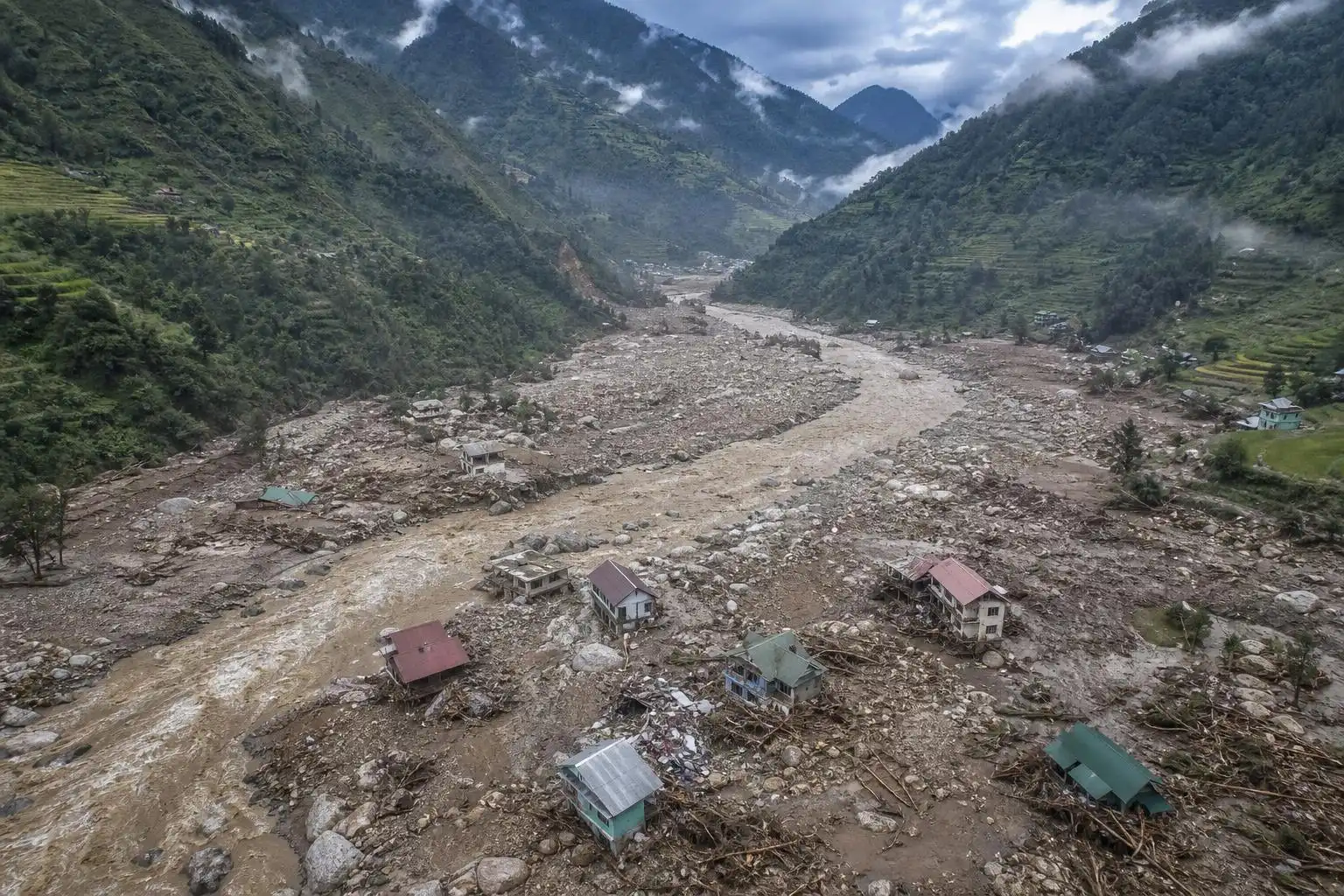

On 26 August, roughly two square kilometres of rock wall and glacier ice let go along the Nepal–China border. What followed was not a single event but a cascade: a rock-ice avalanche that transformed, within minutes, into a debris flood powerful enough to be initially mistaken for an earthquake. Seismometers did register the collapse, but the shaking came from the mountain itself failing, not from tectonic movement.[1] As the mass of ice and rock accelerated downslope, friction generated enough heat to melt some of that ice, adding a surge of meltwater that turned a rockfall into a flood.[1]
The human toll has been severe. Around 1,400 people are confirmed dead across Nepal and neighbouring regions, with thousands still missing three weeks after the disaster.[3] This is the kind of event my field exists to interrogate. Not because attribution changes the grief or the rebuilding, but because it changes what communities plan for next. A rockslide that used to be a once-in-a-millennium curiosity is a very different planning problem than one that recurs on a human timescale.
What Actually Failed on the Mountain
Rock-ice avalanches like this one are not simply a matter of gravity finally winning. They depend on the mechanical integrity of frozen ground and glacier ice that has, for centuries, acted as a kind of natural cement holding steep terrain together. As high-altitude permafrost warms, that cement weakens. Ice within rock fractures thaws and refreezes less reliably, glaciers thin and retreat, and the geometry of slopes that were stable for generations becomes marginal.
The World Weather Attribution assessment describes climate change as a destabilising factor acting on pre-existing geology, rather than the fundamental cause, and says the 2015 earthquake may also have weakened the slope over time.[1] Scientists involved in that analysis told Reuters that climate change is highly likely to have contributed to the collapse, pointing to warming temperatures that have thinned glaciers and melted ice and permafrost buried deep in the region’s bedrock.[3]
This is a harder attribution problem than a heatwave or even a flood. There is no century-long station record of rockfall frequency to feed into a statistical model, and the physical chain — thawing permafrost, ice loss, slope destabilisation, avalanche, meltwater surge, debris flow — has several links, each with its own uncertainties. What attribution scientists can say with confidence is that the background conditions were altered by warming, and that similar events are becoming more physically plausible across the range as temperatures climb.
A Region Warming Faster Than the Global Average
The Himalaya is not warming at the same pace as the planet as a whole; high-altitude regions have consistently shown amplified warming relative to global averages, a pattern also documented in the Arctic and other cryosphere-dominated zones. That matters because the infrastructure, early-warning systems, and settlement patterns across Nepal, Tibet, and neighbouring valleys were built around a climate that no longer exists. Adaptation limits are not an abstract phrase in the attribution literature here; they describe communities that had no meaningful way to prepare for a hazard cascade of this scale and speed.
The broader context helps explain why 2026 has become such a consequential year for the science. The UN Environment Programme said in early September that global temperature rises are set to exceed the 1.5°C threshold within a few years, warning of intensifying extreme weather and mounting pressure on glaciers, ecosystems, and low-lying coastal cities.[4] The Nepal collapse is not a preview of that threshold. It is what crossing into that territory already looks like in a cryosphere under stress.
Heat, Not Just Ice, Is Rewriting the Rulebook
The same summer that destabilised Himalayan slopes also delivered record-breaking heat further west. Britain’s Met Office confirmed that the UK experienced its hottest summer since records began in 1884 — the second consecutive record-breaking summer — with intense heat and drought straining infrastructure, agriculture, and wildfire response.[5] The agency’s head of climate attribution put a number on it: in a climate without human-caused greenhouse gas emissions, a summer like 2026 would occur roughly once every thousand years in Britain.[5]
That kind of shift in return period is the clearest, most legible product of attribution science, because it translates a subjective sense of “unusual weather” into a number decision-makers can actually use. A one-in-a-thousand-year event under a climate without human emissions becoming far more likely under today’s climate is not a rhetorical flourish; it is a shift in the tail of a probability distribution that insurers, engineers, and public health planners now have to design around.
New attribution methodology is starting to close a gap that has long bothered epidemiologists and climate scientists alike: heat is Europe’s leading cause of weather-related death, yet mortality attribution has traditionally been calculated separately from event attribution. A recent framework combines the two, quantifying how anthropogenic warming has altered the likelihood of extreme heat-mortality events across 34 European countries.[2] That fusion matters because it moves the conversation from “was this heatwave unusual” to “how much more likely has climate change made an extreme heat-mortality event” — a far more actionable measure for health ministries.
The Compounding Costs Nobody Budgeted For
Extreme weather rarely stays in its own lane, and 2026 has illustrated that repeatedly. The World Meteorological Organization warned in September that the combination of increasingly intense wildfires and heatwaves is undermining global air quality efforts, noting that pollution from fire smoke can travel far beyond the regions actually burning.[8] Climate change and air pollution, the agency argued, need to be tackled as one interconnected problem rather than through separate policy tracks.[8]
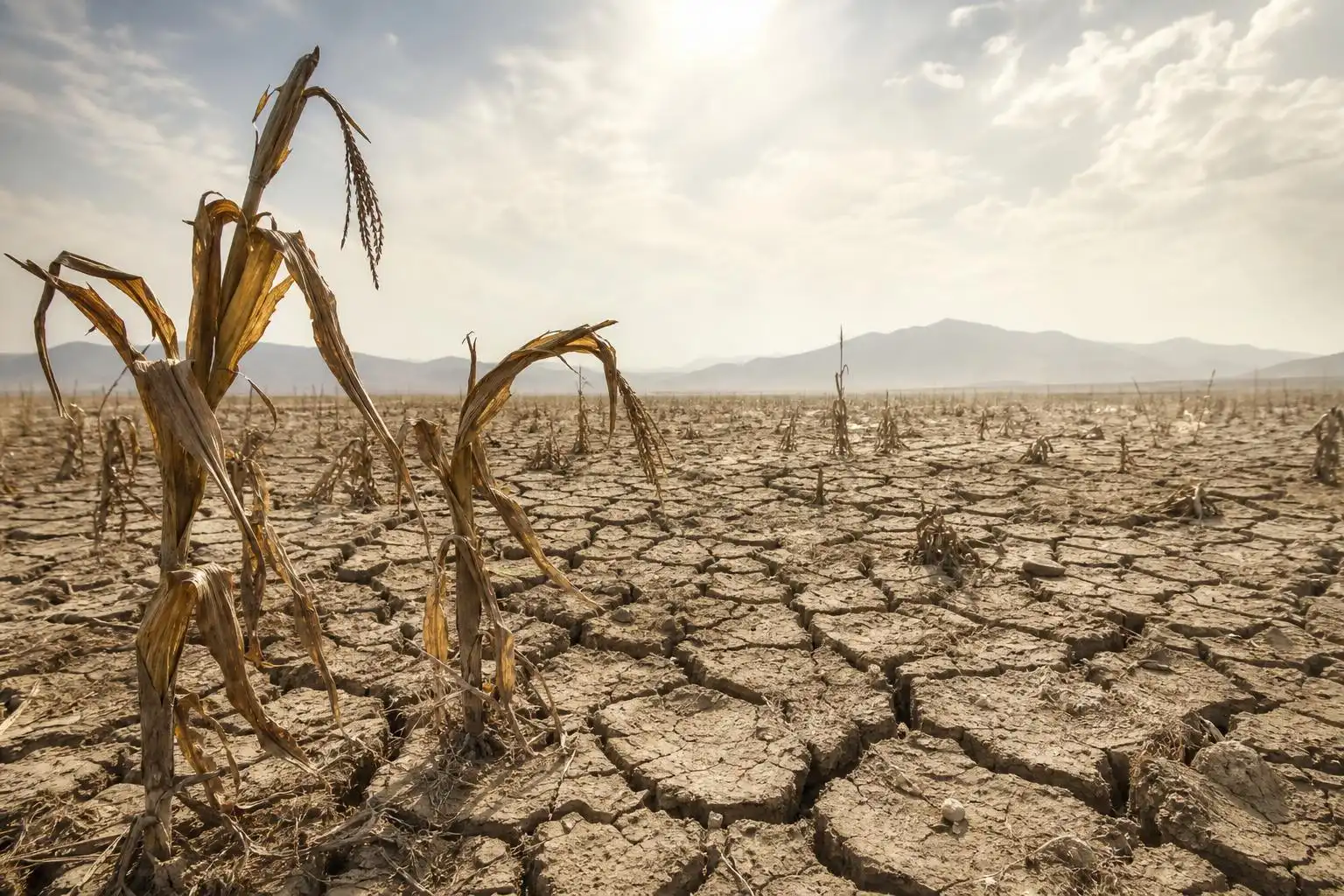
Agriculture has absorbed its own compounding blow. The UN’s Food and Agriculture Organization reported that world food prices hit their highest level since late 2022 in August, as heat and drought across Europe combined with war-related disruption in the Black Sea to push grain prices to three-year highs.[7] Attribution science does not typically stretch as far as commodity markets, but the underlying physical driver — a drought-stricken growing season across a major agricultural region — sits squarely within its territory, and it is a reminder that the costs of a shifting climate distribution extend well past the immediate disaster zone.
Displacement Follows a More Complicated Pattern Than Expected
It would be tempting to assume that climate disasters simply push people to move, but recent research into global subnational migration data complicates that picture. Floods are consistently associated with decreased net migration, with effects lasting several years and appearing stronger in lower-income regions.[6] Droughts show the opposite income pattern, correlating with migration primarily in wealthier settings and typically over shorter timeframes.[6] Tropical cyclones reduce net migration mainly in lower-income areas, with effects again persisting for years.[6]
For a region like the Himalayan valleys hit by the August collapse, this research suggests a sobering possibility: the communities most affected may be the least able to leave, not the most likely to. Prolonged compound exposure to drought in already population-attracting areas is linked to reduced migration inflows, meaning disaster-prone but economically vital regions can become simultaneously more dangerous and harder to abandon.[6]
What the Statistics Actually Demand of Us
None of this is a claim that every rockslide or heatwave is “caused” by climate change in a simple, singular sense. Attribution science works by comparing the odds of an event in today’s warmed climate against the odds in a hypothetical world without human-caused emissions. For UK heat, that comparison indicates that a summer like 2026 would occur roughly once in 1,000 years without human emissions.[5] For a Himalayan glacier collapse, the comparison is necessarily more qualitative, but the direction of the evidence points the same way: warming likely degraded the ice and permafrost, adding to pre-existing geological weaknesses and possible earthquake damage, and made the cascade more likely than it would otherwise have been.[1]
The honest summary of this September is that multiple, independent lines of evidence are converging on the same conclusion from different angles — mortality models in Europe, return-period statistics in Britain, geohazard cascades in the Himalaya, air quality trends worldwide. None of them alone proves the case. Together, they describe a climate system whose tails have moved, producing events that adaptation plans built for the twentieth century were never designed to absorb.
References
- Rapid Warming in the Himalaya Exacerbates Geohazard Cascades Beyond Adaptation Limits — https://www.worldweatherattribution.org/rapid-warming-in-the-himalaya-exacerbates-geohazard-cascades-beyond-adaptation-limits/
- Extreme event attribution for heat-related mortality due to anthropogenic climate change across Europe — https://www.nature.com/articles/s44360-026-00193-z
- Climate change likely to have helped trigger Nepal glacier collapse, scientists say — https://www.reuters.com/sustainability/cop/climate-change-likely-have-helped-trigger-nepal-glacier-collapse-scientists-say-2026-09-17/
- Global temperature rises to exceed 1.5 Celsius ‘within a few years’, UNEP says — https://www.reuters.com/sustainability/cop/global-temperature-rises-exceed-15-celsius-within-few-years-unep-says-2026-09-02/
- UK summer was hottest on record, Met Office says, after severe heat, drought — https://www.reuters.com/business/environment/uk-summer-was-hottest-record-met-office-says-after-severe-heat-drought-2026-09-01/
- Compound and heterogeneous relationships between climate extremes and global net migration — https://www.nature.com/articles/s41558-026-02752-4
- World food prices at highest since 2022 as supply risks mount, FAO says — https://www.reuters.com/world/europe/world-food-prices-highest-since-2022-supply-risks-mount-fao-says-2026-09-04/
- Wildfires, heat waves threaten to undermine air quality, UN weather agency says — https://www.reuters.com/sustainability/cop/wildfires-heat-waves-threaten-undermine-air-quality-un-weather-agency-says-2026-09-07/


Leave a Reply