

A prediction that the Atlantic meridional overturning circulation, or AMOC, could collapse around mid-century is easy to misread. It sounds like a forecast of something already visible in the ocean, with a date attached. In fact, the widely discussed date comes from a statistical interpretation of sea-surface temperatures—not a direct measurement of the circulation approaching a threshold. That distinction does not make the result unimportant. It determines what the result can tell us.
I think an AMOC collapse this century is a serious risk that climate models may understate. I do not think the evidence presently supports a dated forecast of collapse. The strongest reason to keep the risk on the table is a physical model experiment that produces a collapse. The strongest reason to resist the date is that the observed temperature pattern used to infer it has more than one plausible cause. Those two findings need to be held together rather than used to cancel each other out.
A temperature fingerprint cannot, by itself, date a tipping point
In a 2023 Nature Communications paper, Peter and Susanne Ditlevsen analyzed sea-surface temperature variability in a North Atlantic region often used as an indirect indicator of AMOC strength. Their statistical model detected changes consistent with an approaching tipping point. Under its assumptions, it placed a possible collapse between 2025 and 2095, with a central estimate around 2057. That result deserved attention: it challenged the reassuring habit of treating an abrupt change before 2100 as practically impossible.
But the inference runs through two demanding steps. First, temperatures in that region must track changes in the overturning reliably enough to serve as its proxy. Second, the changing variability in that proxy must chiefly reflect the circulation losing stability as external forcing pushes it toward a threshold. If either relationship shifts over time, a narrow-looking statistical result can become a poor guide to the ocean’s future. The reported interval describes uncertainty within the fitted framework; it cannot encompass every way the framework might be wrong.
The North Atlantic does not cool or warm in response to overturning alone. Winds move the boundary between warm and cold waters, surface heat exchange changes with weather, and atmospheric aerosols have affected regional temperature trends. The subpolar gyre also redistributes heat without being identical to the basin-wide overturning. A temperature record beginning in the nineteenth century is valuable, but it is not a continuous observation of the AMOC. Calling it a fingerprint is reasonable; treating that fingerprint as a flow meter is not.
There is another difficulty with a calendar-year prediction. The Ditlevsens’ analysis assumes that the process generating the warning signal can be represented as a system steadily approaching a particular kind of tipping point. Greenhouse forcing is rising, but the regional ocean’s response need not be steady. Freshwater from ice melt, precipitation, and changing winds can act on different schedules, while internal variability can obscure or mimic a trend. The question is not whether a statistical warning signal can exist. It is whether this particular record isolates one well enough to date an event.
That is why I would not translate “2057” into “the AMOC will collapse in 2057.” Nor would I discard the paper because its proxy is imperfect. Its useful claim is sharper than either reaction: observed variability raises a testable concern about stability that direct circulation measurements and physically grounded models should confront. A warning indicator is most valuable when it prompts a search for independent evidence, not when it is promoted into a clock.
A model collapse shows a credible mechanism, not a deadline
In 2024, René van Westen, Michael Kliphuis, and Henk Dijkstra published a Science Advances experiment using the Community Earth System Model. They gradually increased freshwater input into the North Atlantic until the simulated AMOC collapsed. As northward transport of warm, salty water weakened, the northern Atlantic received less salt. That made surface waters less dense and less able to sink, further weakening the circulation. The feedback is physically intelligible, and the experiment showed a system-wide transition rather than an isolated temperature anomaly.
This is the strongest counterweight to any argument that AMOC collapse belongs only in speculative statistics. It can occur in a comprehensive climate model with interacting atmosphere and ocean. The researchers also examined a diagnostic based on freshwater transport by the overturning at the southern boundary of the Atlantic. In their experiment, its evolution provided advance warning of the transition. That offers a more mechanistic target for monitoring than a surface-temperature patch alone.
Yet the experiment did not discover how much freshwater the real Atlantic will receive over the next several decades, or on what timetable. Its imposed freshwater increase was designed to probe stability. A response to that intervention establishes that the modeled circulation can tip; it does not establish that emissions, Greenland melt, and rainfall changes will reproduce the intervention by mid-century. Confusing a controlled stress test with a forecast would weaken the paper’s most important contribution.
It also exposes a problem for an easy appeal to the wider CMIP6 ensemble. A model that fails to collapse under a standard emissions scenario may genuinely be telling us that collapse is unlikely. It may instead have a freshwater balance, mixing scheme, or circulation structure that makes its AMOC too stable. The sign and magnitude of Atlantic freshwater transport differ across models, and those differences matter to the salt feedback. Counting simulations with and without collapse is not the same as establishing that they sample the real ocean’s stability fairly.
I therefore take a position between two claims often presented as opposites. Van Westen and colleagues provide strong evidence that a physically credible tipping mechanism exists. The Ditlevsens provide a reason to scrutinize observational warning signals. Neither result, alone or in combination, identifies a collapse year. For that, we would need to know both the real circulation’s distance from a threshold and the future forcing that moves it—quantities that remain inadequately constrained.
The direct observations test weakening better than proximity to collapse
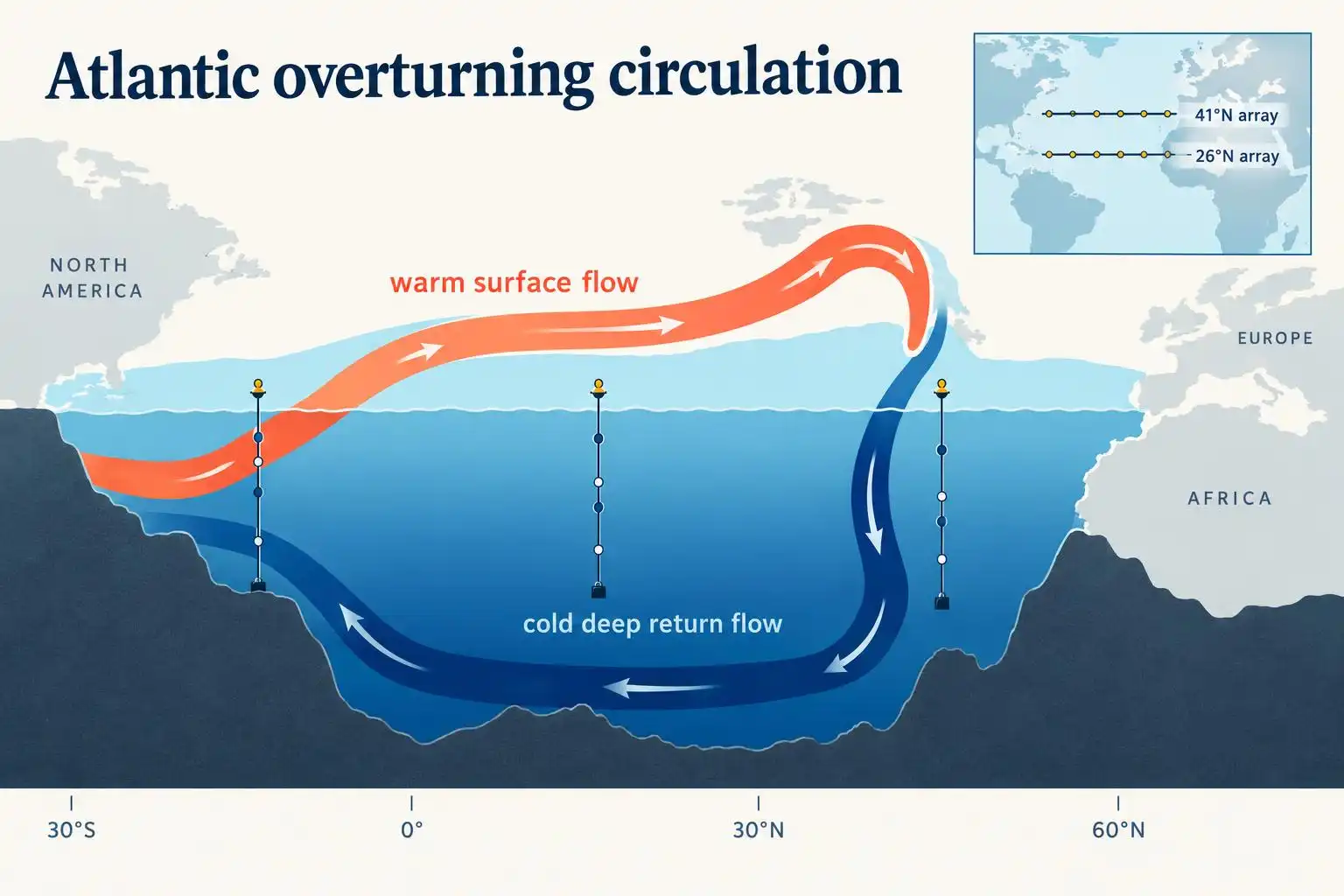
The RAPID array has measured overturning across the Atlantic near 26.5°N since 2004. It has recorded large fluctuations and a decline over part of its observational period. Those measurements are indispensable, but roughly two decades is short compared with the ocean’s longer variations. A trend estimated from that window can depend strongly on its starting and ending years. It would be a mistake to demand that RAPID already prove or disprove a century-scale tipping forecast.
Measurements farther north add a complication rather than a simple verdict. The OSNAP program, operating across the subpolar North Atlantic since 2014, has shown that overturning variability involves the eastern subpolar Atlantic and Nordic Seas more strongly than an older picture centered on Labrador Sea deep convection suggested. That matters because a single temperature region—or even a single latitude of direct transport measurements—cannot stand in for every part of the circulation. Water-mass formation, gyre exchange, and transport can change together without changing in lockstep.
A convincing observational case for approaching collapse would connect independent measurements. I would want a persistent decline in overturning transport across observing arrays, accompanied by salinity and density changes in the regions that feed deep-water formation. I would also want evidence that the Atlantic’s salt transport is shifting in the direction expected from the proposed positive feedback. These need not emerge simultaneously, and natural variability will make each noisy. Their agreement would matter far more than one more unusually cold year in the subpolar Atlantic.
A warmer North Atlantic in any given year would not settle the question either. The AMOC moves heat within a planet that is warming overall; an area can warm while its heat transport weakens. Conversely, a cool anomaly does not demonstrate a weakening AMOC. This is why the observational test must be framed around transport, salinity, density, and the consistency of their changes—not around whether a map resembles the familiar “cold blob.”
The present evidence therefore supports an asymmetry. We have good physical reasons to expect an AMOC weakening as the climate warms, and direct observations with which to investigate that change. We do not yet have a long, complete record that measures distance to a tipping threshold. Absence of that record is not evidence of safety. It is a limit on how confidently anyone can attach a decade to collapse.
I would change my mind if independent measures converged
The IPCC’s Sixth Assessment Report concluded that the AMOC is very likely to weaken during the twenty-first century, while expressing medium confidence that it will not undergo an abrupt collapse before 2100. I think that is a defensible distinction, provided “medium confidence” is not repackaged as a guarantee. Models and observations both have known limitations here. An unlikely event with large consequences deserves attention even when its date cannot be calculated reliably.
The strongest objection to my caution is that waiting for a decisive direct record could mean waiting until useful warning time is gone. Tipping systems can look variable until they change rapidly; an imperfect early warning may be the only one available. I agree with the practical implication. We should not require proof of imminent collapse before improving observations or examining the consequences of a substantial weakening. But acting on a serious risk does not require pretending that a proxy-based date is independently verified.
What would make me more persuaded by a near-term collapse forecast? First, an early-warning pattern would need to persist across independently constructed AMOC proxies, rather than depend heavily on one sea-surface-temperature region. It would need to survive tests for changing aerosol forcing, winds, and subpolar gyre behavior. Then direct transport and water-property measurements would need to move coherently with the proposed loss of stability. Finally, models that reproduce those observed relationships would need to show a comparable transition under plausible, not merely diagnostic, freshwater forcing.
I would move the other way if sustained observations showed that the circulation and Atlantic salt feedback remained stable despite continued warming, and if models matching those observations consistently resisted collapse across credible forcing ranges. That would not prove an abrupt change impossible after 2100. It would weaken the specific claim that today’s temperature variability is telling us a collapse is already imminent.
The honest conclusion is less tidy than either “collapse by 2057” or “models rule it out.” We have a mechanism demonstrated in a climate model, an intriguing but contestable statistical warning, and direct measurements that are still too short to arbitrate between them. I take the possibility of collapse seriously enough to demand better tests. I do not take a precise collapse date seriously until the ocean supplies evidence that is independent of the method that produced it.



Leave a Reply
You must be logged in to post a comment.