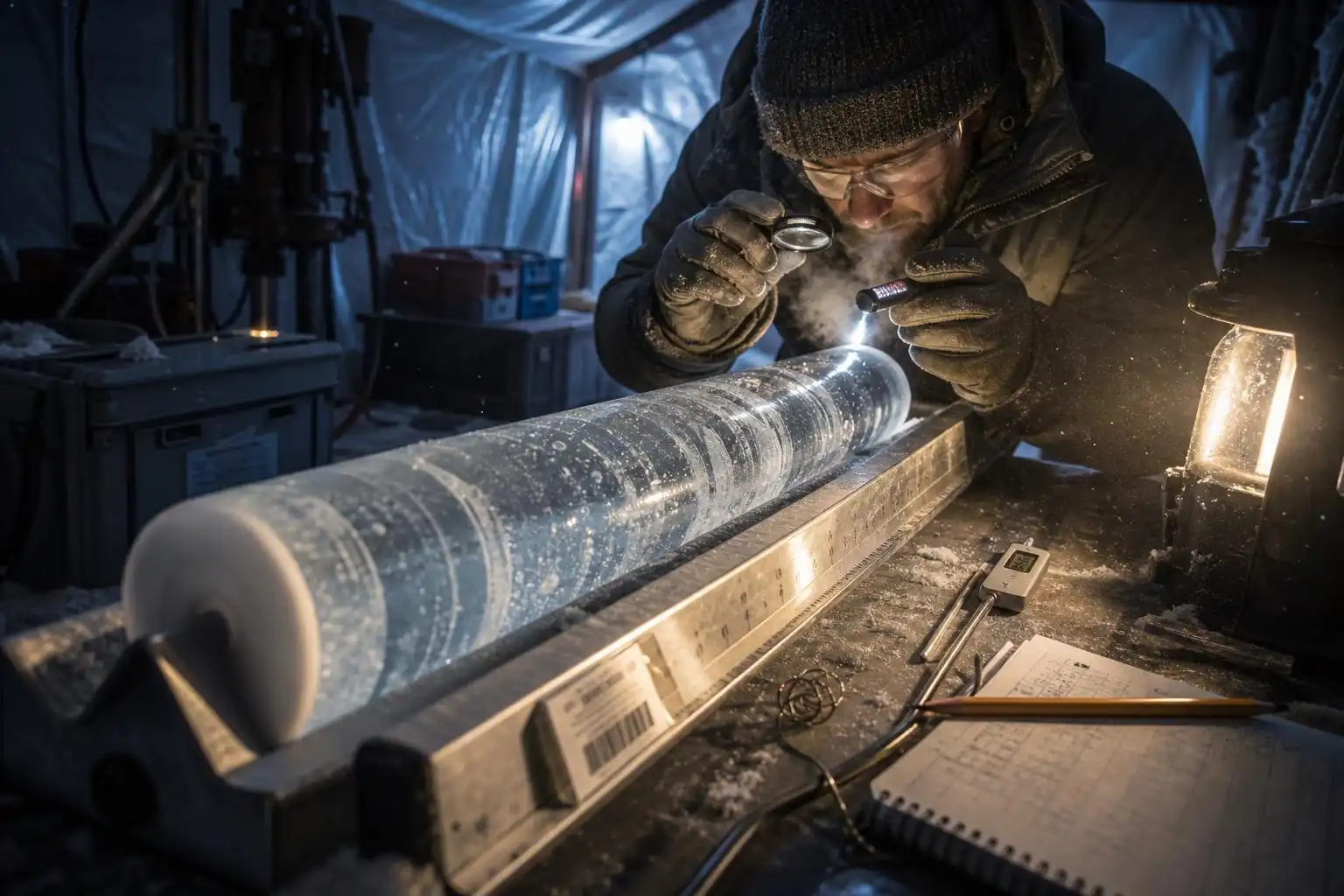

There is a moment, somewhere around 3,000 metres of depth in an Antarctic ice core, when you stop thinking in years and start thinking in epochs. The ice you are holding — grey-blue, dense, threaded with ancient air bubbles — was compacted from snow that fell before our species existed. The dust trapped inside it blew off continents that looked almost, but not quite, like the ones we know. And the CO₂ locked in those tiny bubbles tells a story that no thermometer, no weather station, no satellite has ever recorded directly.
That story is the one I keep returning to when I hear debates about how sensitive the climate really is to rising greenhouse gases. Because the ice does not argue. It simply remembers.
The Question That Drives Everything
Climate sensitivity — formally, the equilibrium climate sensitivity, or ECS — is the amount of global average warming you get when you double atmospheric CO₂ and let the system fully adjust. It sounds like a narrow technical parameter. It is not. It is arguably the single most consequential number in all of climate science. A world with an ECS of 2°C behaves very differently from one with an ECS of 4°C, and the difference between those two worlds determines whether the targets in the Paris Agreement are achievable or already out of reach.
For decades, the likely range for ECS sat at 1.5°C to 4.5°C — a span so wide it was almost an admission of uncertainty. The Sixth Assessment Report from the IPCC narrowed that to 2.5°C–4°C, with a best estimate of 3°C, and assessed values above 5°C as “very unlikely.” That narrowing came partly from better models and better observations, but it also came from something that gets less attention than it deserves: the deep past.
What Glacials and Interglacials Actually Show
The ice core record from Antarctica — the EPICA Dome C core in particular, which my colleagues and I have spent years working with — covers eight complete glacial-interglacial cycles, stretching back 800,000 years. Over that span, CO₂ oscillated between roughly 180 parts per million during cold glacial maxima and about 280 ppm during warm interglacials. Temperature at the drilling site tracked those swings closely, with a lag that tells us a great deal about feedbacks.
The relationship is not perfectly linear, and it is not simple. The Earth’s orbital geometry drives the initial nudge — small changes in the shape of the orbit and the tilt of the axis alter how solar energy is distributed across the planet. But those orbital changes alone are far too weak to explain the full 5–6°C difference in global mean temperature between a glacial maximum and an interglacial. The amplification comes from feedbacks: ice-albedo feedback as ice sheets grow and shrink, water vapour feedback as a warmer atmosphere holds more moisture, and — critically — the CO₂ and methane feedbacks as carbon cycles in and out of the ocean and permafrost.
This is how paleoclimate constrains ECS. If we know how much forcing changed between a glacial and an interglacial, and we know how much temperature changed, we can work backwards to estimate how sensitive the system is per unit of forcing. The answer, consistently, lands in the range of 2.5°C–4°C per CO₂ doubling — right in line with the IPCC’s current best estimate.
This is not a coincidence. It is the ice telling us something true.
The Last Interglacial: A Warning Written in Coral and Sediment
The most instructive single period in the recent geological record is the Last Interglacial, roughly 125,000 years ago. Global mean temperatures were about 0.5–1°C warmer than pre-industrial levels — modest by the standards of what we are doing now. But the sea level was somewhere between 5 and 9 metres higher than today.
Let that number sit for a moment.
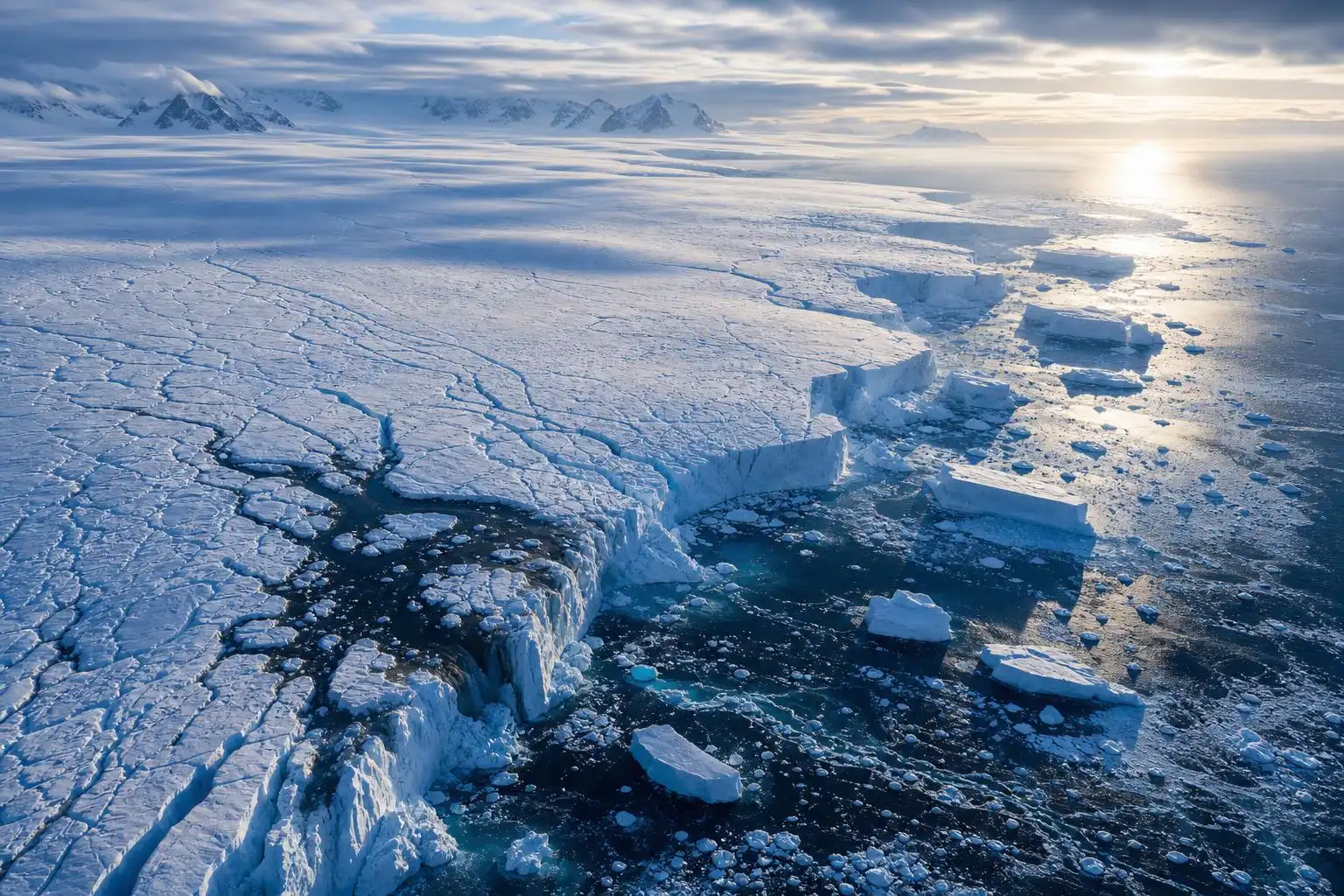
The Greenland Ice Sheet contributed perhaps 1–2 metres. The rest came primarily from West Antarctica, and possibly from parts of East Antarctica that we once thought were stable. The ice sheets did not need to be dramatically warmer than today to lose that much mass; they needed sustained warmth, over millennia, to cross thresholds that are not easily reversed.
We are currently tracking toward sustained warmth that would dwarf what the Last Interglacial saw, and we are doing it on a timescale of decades rather than thousands of years. The orbital forcing that drove the Last Interglacial was gradual. Ours is not.
The sediment cores from the continental shelves around Antarctica — cores that record the advance and retreat of ice through layers of microfossils and dropstones — confirm this picture. They show that the West Antarctic Ice Sheet has collapsed before, under conditions less extreme than what current trajectories imply. The question is not whether it can happen. The question is how quickly.
The Pliocene Analogue
Go further back — about 3 million years, to the mid-Pliocene warm period — and CO₂ levels were similar to today’s, hovering around 380–420 ppm. Global temperatures were 2.5–4°C warmer than pre-industrial. Sea levels were 10–25 metres higher.
The Pliocene is not a perfect analogue for our future. The continents were in slightly different positions, ocean circulation was somewhat different, and the forcing arrived over geological timescales rather than a human lifetime. But it is the closest natural experiment we have for a world with roughly today’s CO₂ concentration, and it is sobering.
The PRISM (Pliocene Research, Interpretation and Synoptic Mappings) project has spent years reconstructing Pliocene climates from sediment cores, pollen records, and fossil assemblages. Their work feeds directly into model validation: if a climate model cannot reproduce the Pliocene, we have good reason to distrust its projections for the future. The models that perform best against Pliocene data tend to cluster toward the higher end of the ECS range — not at the reassuringly low end.
The Palaeocene-Eocene Thermal Maximum: A Cautionary Tale About Speed
For a glimpse of what rapid carbon release looks like in the geological record, the Palaeocene-Eocene Thermal Maximum (PETM), about 56 million years ago, is the most studied example. A massive pulse of carbon — possibly from volcanic activity destabilising seafloor methane hydrates — raised atmospheric CO₂ sharply and pushed global temperatures up by 5–8°C over roughly 20,000 years. Ocean acidification was severe. Species ranges shifted dramatically. Recovery took around 200,000 years.
The PETM carbon release was probably 2,000–5,000 gigatonnes of carbon over millennia. We have already emitted more than 600 gigatonnes since industrialisation began, and we are doing it in centuries, not millennia. The rate matters enormously. Ecosystems and ice sheets that could adapt slowly to a gradual warming cannot adapt at all to an abrupt one.
The PETM also offers a direct constraint on ECS. Researchers who have reconstructed the CO₂ forcing and temperature response during that event arrive at sensitivity estimates consistent with the modern range — another data point confirming that the physics has not changed.
Why the Ice Matters for the Debate We Are Having Now
I am sometimes asked why any of this matters for contemporary climate policy. The answer is that it matters precisely because it is not a model. Models are essential — I use them constantly — but they carry assumptions, parameterisations, and structural choices that can be questioned. The ice core record, the sediment record, the fossil coral record: these are empirical archives. They are what actually happened.
When those archives, spanning millions of years and dozens of independent proxies, consistently point toward an ECS in the range of 2.5°C–4°C, and when the most sophisticated modern models converge on the same range, the convergence is not accidental. It is the signal emerging from the noise.
It also means that the low-sensitivity scenarios — the ones where we can safely overshoot 2°C of warming and then pull back without triggering irreversible changes — are not well supported by what the deep past shows. Ice sheets, once destabilised, do not wait for policy frameworks to catch up. The Last Interglacial sea levels were not a model output. They were a fact, written in coral reefs that are now stranded metres above the waterline on tropical coastlines.
Reading the Record Honestly
There is a version of paleoclimate communication that is falsely reassuring: the Earth has been warmer before, life survived, the planet is resilient. All of that is technically true. The Earth has been warmer. Life — in some form — survived. The planet is, in a geological sense, resilient.
But the civilisation we have built is not optimised for a Pliocene climate. The coastlines where billions of people live, the agricultural systems that feed them, the freshwater sources stored in glaciers and snowpack — none of these were designed around a world 3°C warmer with seas 15 metres higher. The geological record shows that such a world is physically possible at current CO₂ levels. It does not show that it is survivable for modern human society in any recognisable form.
The ice cores I have spent my career studying are not a message of doom. They are a message of precision. They tell us, with remarkable clarity, how sensitive this system is, how quickly it can shift, and how long the consequences persist. That precision is a gift — if we choose to use it.
Standing at the drilling site in the dark of an Antarctic winter, with the wind cutting through every layer you own and the ice stretching away in every direction, you develop a particular relationship with geological time. The urgency of the present moment does not shrink in that context. It grows. Because the ice is patient, and it has seen this before, and it knows exactly what comes next.


Leave a Reply