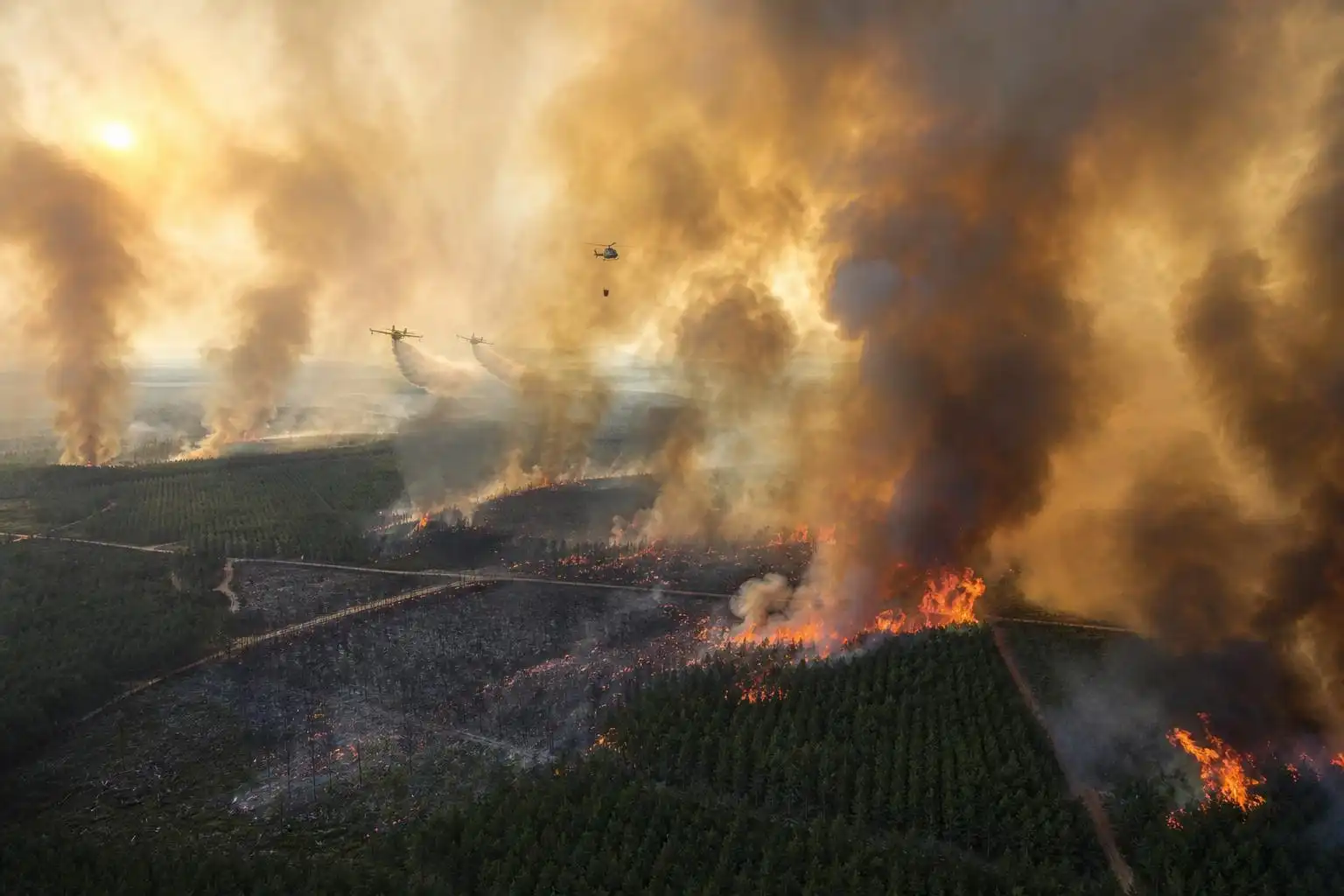

The question arrives with every disaster, reliable as smoke on the wind: did climate change cause this? By now, the summer of 2026 in western Europe has given us an almost embarrassing abundance of material to work with — back-to-back heatwaves, months of drought, and wildfires consuming landscapes from the Landes to central and eastern Spain. My job is to resist the temptation to answer that question with a simple yes or no, and instead explain what the science actually says. The answer is more interesting, and more sobering, than either.
A Season of Compounding Extremes
Let’s start with the facts on the ground. By the end of July 2026, southwestern France and central and eastern Spain were battling widespread, intense wildfires. The fires arrived after months of drought and a succession of at least three distinct heatwave events — with a fourth forecast before July was even out.[1] France recorded its hottest June since records began, surpassing even the catastrophic August 2003 heatwave that killed tens of thousands across the continent. Firefighters from multiple EU member states were deployed through the European Union Civil Protection Mechanism in a coordinated scramble to contain blazes that no single national service could handle alone.[1]
Across the Atlantic, Canada was simultaneously enduring its own extreme fire season. In Ontario, extreme heat, dry conditions, and strong winds intensified wildfire activity through July, while widespread lightning storms ignited numerous new fires even as crews struggled to contain existing ones. In the Northwest Territories, the 30-day fire weather index reached return periods that, in a climate 1.4°C cooler, would have been expected only once every 100 years.[3] Remote and Indigenous communities bore the sharpest edge of that risk, with some suffering extensive damage or destruction as fires spread faster than evacuation could follow.[3]
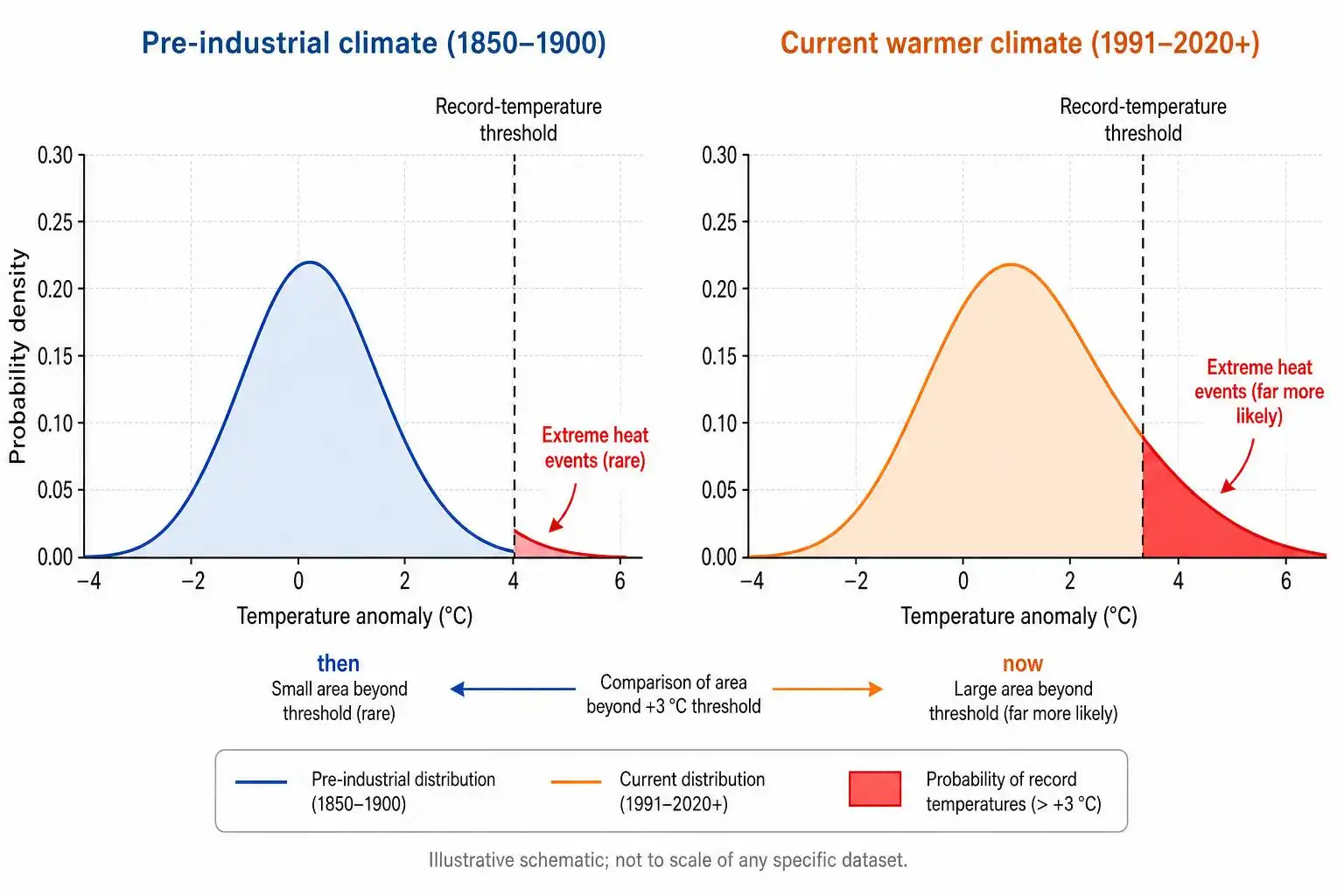
This is not a European story or a Canadian story. It is a story about what happens when a shifted probability distribution collides with landscapes and communities that were designed for the old one.
The Logic of Attribution: Shifting the Odds
Here is the core concept that I find myself explaining constantly, and that I think is the key to understanding everything that follows. Climate attribution science does not ask whether an event would have happened without climate change. Extreme weather events — heatwaves, droughts, wildfires — have always occurred. The question we ask is: how much has climate change altered the probability and intensity of what we observed?
Think of it like a loaded die. If I roll a six, I cannot say the loading “caused” the six — a fair die can also roll a six. But if the loading makes sixes five times more likely, that matters enormously for how often you lose the game.
The World Weather Attribution analysis of the French June 2026 heatwave found that such temperatures were tens to hundreds of times more likely to occur in 2026 than they would have been in 2003 — itself already a world warmed by roughly 0.7°C above pre-industrial levels.[1] That is not a subtle statistical signal. That is the distribution shifting so far that events which were once statistical outliers are becoming the new centre of gravity.
Compounding: Why the Whole Is Worse Than the Sum of Its Parts
What makes the summer of 2026 particularly instructive for attribution science is the role of compounding. A single heatwave is dangerous. A heatwave layered on top of months of drought, followed by another heatwave, followed by a third, creates conditions that are qualitatively different — not just quantitatively worse.
This compounding logic applies to wildfire risk with special force. Drought desiccates vegetation and soil. Heat accelerates evapotranspiration, drying the landscape further. Low humidity and wind then provide the ignition environment. Each of these drivers can be attributed individually to climate change; their simultaneous occurrence is what produces the “tinderbox conditions” that the WWA report describes.[1]
The same compounding logic frustrates the insurance industry. Heat rarely causes the kind of single, identifiable physical damage event that insurers can cleanly model. Instead, it interacts with drought, wildfire, and water shortages to produce cascading losses that are difficult to attribute to any one trigger.[7] A 2023 survey found that only 28% of small and medium-sized European firms held business interruption cover as part of their property insurance, and just 17% had non-damage business interruption protection.[7] The insurance gap is, in part, a compounding gap — the industry’s models were not built for a world where heat, drought, and fire arrive together and reinforce each other.
Return Periods and the Danger of Static Benchmarks
The concept of a “return period” — the idea that a given event has, say, a 1-in-100-year probability — is deeply embedded in infrastructure design, flood management, and emergency planning. It is also becoming dangerously misleading if applied without accounting for a shifting climate.
The Canadian wildfire data illustrates this precisely. Events that, in a 1.4°C cooler climate, would have had 100-year return periods are now occurring on timescales of six years or less in some regions.[3] A dam, a levee, or a forest management plan designed to the old return period is now systematically under-engineered for the world it actually inhabits.
Historical records can help calibrate our sense of what is possible — but they, too, require careful interpretation. A recent study of the catastrophic European floods of 1342, which cascaded across the continent on a scale exceeding anything in recent decades, demonstrates that sequences of very large flood events are not only possible but precedented, and that climate projections suggest an increase in the extreme extratropical cyclones that could produce them again.[4] The lesson is not that we should be paralysed by historical worst cases, but that our planning horizons need to expand in both directions — into the past, to understand the full range of natural variability, and into the future, to account for a distribution that is continuing to shift.
The Ocean Is Not Spared
Attribution science is not limited to atmospheric events. European ocean temperatures in 2026 have also been unprecedented, with severe impacts for marine life. WWA analysis finds that if warming reaches 2.8°C above pre-industrial levels — the trajectory implied by current policies — the marine heatwave events observed in 2026 would be another 1.3°C to 1.9°C more intense.[2] Marine ecosystems, like fire-adapted landscapes, have tolerances that were calibrated to a different climate. The rate of change is now outpacing adaptation.
What Attribution Is Not
I want to be careful about what attribution science can and cannot tell us, because the misuse of these findings in both directions — alarmist overclaiming and dismissive underclaiming — does real harm.
Attribution science does not tell us that every extreme event is caused by climate change. It tells us about changed probabilities and intensities. It does not tell us that mitigation is futile because the fires are already burning. The difference between 1.5°C and 2.8°C of warming is the difference between “tens to hundreds of times more likely” and “even more extreme than that” — a distinction that matters enormously for the communities on the front line. And it does not tell us that adaptation is sufficient on its own; a world in which we only adapt to an ever-worsening baseline, without reducing emissions, is one in which adaptation eventually fails.
What it does tell us is this: the summer of 2026 is not bad luck. It is not an anomaly that will be followed by a return to normal. It is a signal — statistically robust, physically understood, and directionally unambiguous — that the distribution of extreme weather has shifted, and will continue to shift as long as greenhouse gas concentrations rise.
The fires burning across France and Spain right now are not a metaphor. They are data.
References
-
Climate change increases likelihood of compounding drivers of severe wildfire conditions in France and Spain – World Weather Attribution — https://www.worldweatherattribution.org/climate-change-increases-likelihood-of-compounding-drivers-of-severe-wildfire-conditions-in-france-and-spain
-
Climate change is driving unprecedented European ocean temperatures, with severe impacts for marine life – World Weather Attribution — https://www.worldweatherattribution.org/climate-change-is-driving-unprecedented-european-ocean-temperatures-with-severe-impacts-for-marine-life
-
Climate change means extreme fire seasons in Canada – World Weather Attribution — https://www.worldweatherattribution.org/climate-change-canada-wildfires-2026
-
Cascading continental-scale floods across Europe in 1342 – Nature — https://www.nature.com/articles/s41586-026-10888-8
-
Europe’s heatwaves expose insurance gap as business losses mount – Reuters — https://www.reuters.com/business/europes-heatwaves-expose-insurance-gap-business-losses-mount-2026-08-16



Leave a Reply