
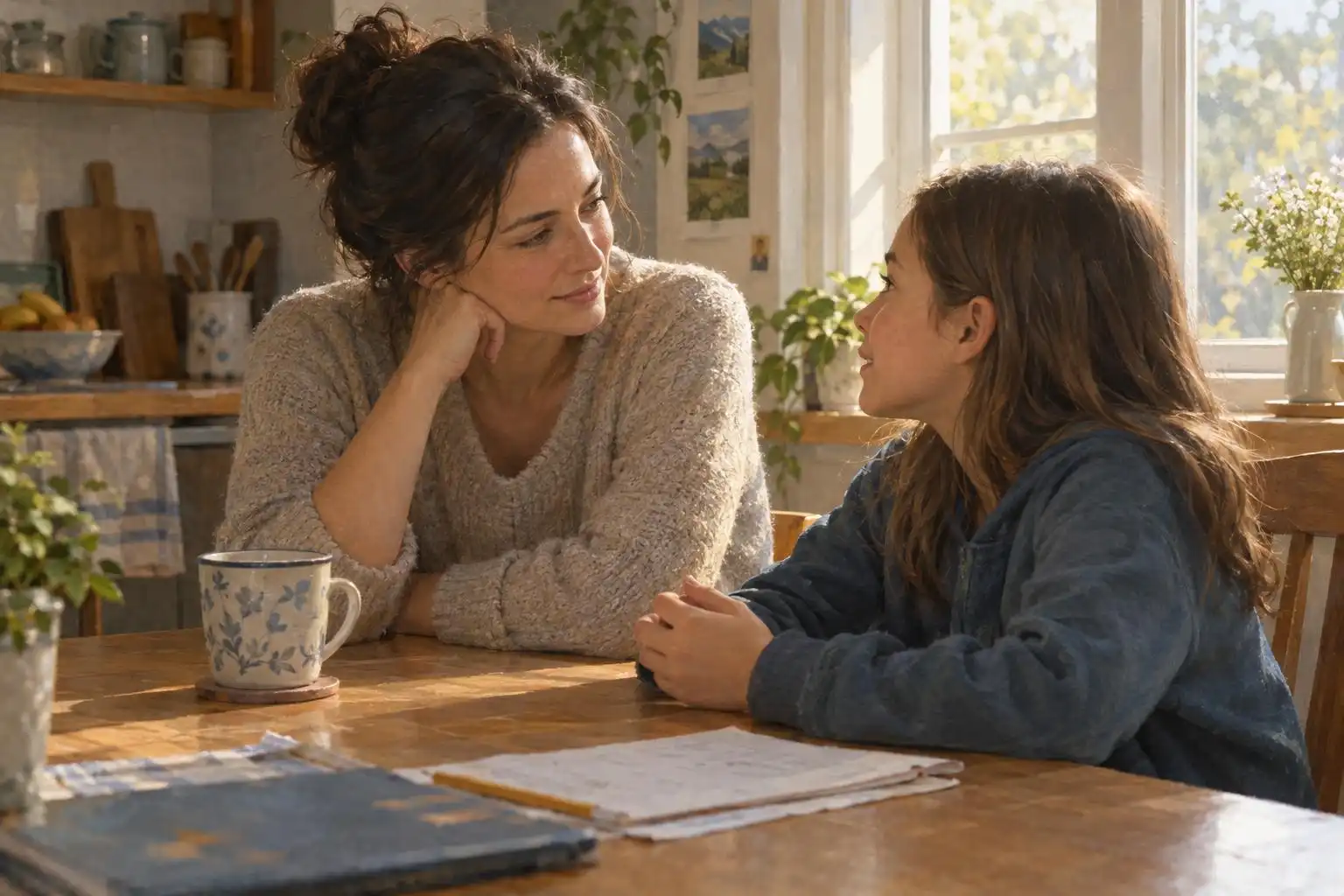

Maybe the question came from a wildfire video. Maybe it came after a hot day when recess was moved indoors. Your child asks, “Will climate change mean I don’t have a future?” and you want to answer immediately. You also know that “Everything will be fine” isn’t a promise you can make.
You do not need to settle the next fifty years over dinner. Your first job is to find out what your child means by future. Are they asking whether people will survive? Whether they can live in your town? Whether the adults they love will keep them safe? Those are different questions. A useful answer begins with the one your child is actually asking.
Start with what they heard, not what you know
Before offering facts, try: “That sounds frightening. What made you wonder about it?” Listen for the specific image or claim behind the question. A child who has heard “the Earth will be unlivable in ten years” needs a different answer from one who watched a flood reach a neighbor’s house. Correcting the wrong fear can leave the real one untouched.
It is also reasonable to ask, “When you say ‘no future,’ what are you imagining?” You are not putting ideas in their head; you are giving them room to describe what is already there. Some children will have one concrete worry. Others will say “everything.” Either way, you can begin by saying that climate change is real, that adults are responsible for working on it, and that your child does not have to solve it alone.
If they want a short answer right away, try: “Climate change will make some things harder, and it already is for some people. It does not mean you won’t grow up or have a life. People can still make the future safer, and we are going to pay attention to what happens where we live.” That is more solid than a blanket reassurance because you can stand behind every part of it.
The conversation may stop there, especially with a younger child. That is not a failure to explain enough. You can return to it when they ask again, as they probably will. A calm answer they can absorb is more useful than an exhaustive one delivered because you are frightened too.
What “a future” means in a changing climate
Climate change is not a single event that makes the whole planet safe one day and unsafe the next. Its effects vary by place, by the kind of hazard, and by the resources people have to protect themselves. A child in a flood-prone neighborhood may face a different risk from one whose school increasingly closes for dangerous heat or smoke.
Nor does a warmer future mean that every ordinary hope disappears. People will still have friendships, work, birthdays, music, and places they love. Some will also face losses that should not be softened into a lesson about resilience. The honest answer holds both possibilities: a life worth planning for and real reasons to reduce harm.
The IPCC’s assessment of climate research is clear that risks rise as warming increases. It is also clear that choices made this decade affect the scale of future risks. That does not amount to a guarantee for any particular child or town. It does mean that “nothing we do matters” is not what the evidence says.
This distinction helps with alarming headlines. A record-hot year, a devastating fire, or a warning about a warming threshold is serious news. None is a scientific announcement that your child’s life is canceled. If your child repeats a claim like that, you can say, “Let’s look at what the report actually says.” You need not turn the conversation into a debate about graphs to challenge a frightening conclusion.
Be honest about whose risk you mean
Children notice when adults speak about “our future” as though everyone faces the same one. They do not. Exposure to heat, flooding, and other hazards matters, but so do housing, health, income, and whether help is available after a disaster. UNICEF’s work on children and climate risk emphasizes that children’s vulnerability is shaped by circumstances, not just by the weather outside.
If your family has air conditioning, reliable transport, or relatives you could stay with during an evacuation, those are meaningful protections. They are not reasons to feel guilty in front of your child. They are reasons to recognize that protection can be shared and improved. Likewise, if your family lacks one of those things, your child deserves practical help, not a speech about being brave.
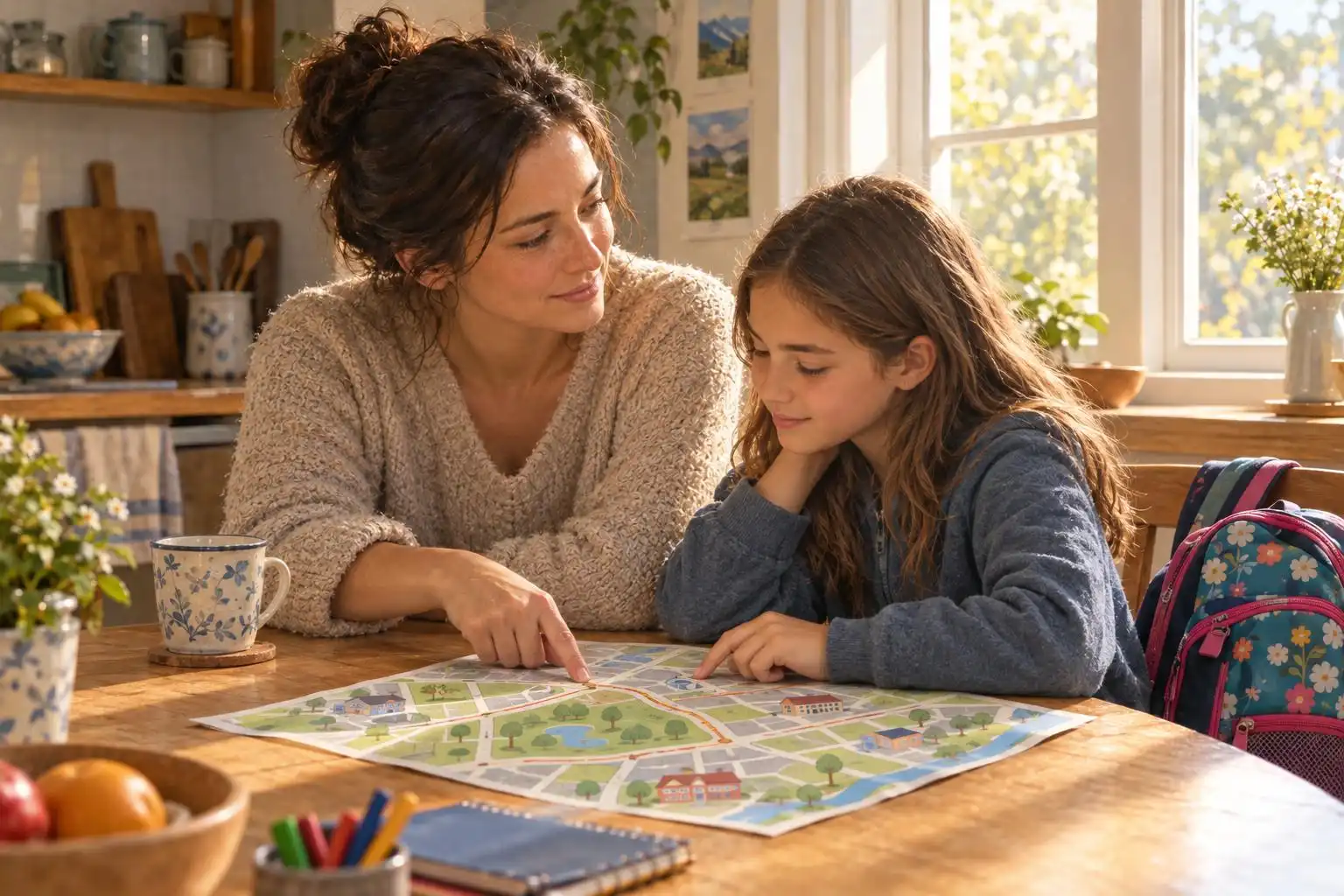
You can make this local without pretending to predict everything. “The biggest weather worry for us right now is summer heat, so we watch for very hot days and know where to cool off,” is a useful sentence if heat is your concern. If a flood map, evacuation notice, or school message is more relevant, start there instead. The point is to replace an endless, everywhere-at-once threat with a risk you can identify and respond to.
Do not confuse a plan with a promise that nothing bad will happen. Children can understand the difference: “We cannot control every storm. We can know where we would go and who we would call.” That tells them the adults are paying attention. It also gives you an opening to check whether the plan you have described actually exists.
Give them a role that fits their age
When a child asks, “What can I do?” it can be tempting to hand them a set of household rules. Those may be fine, but they do not answer the fear that the future depends on their perfect behavior. No child should have to carry responsibility for a global problem in order to feel hopeful about growing up.
Instead, offer a role with visible boundaries. A young child might help choose what goes in a heat-day bag or decide which neighbor to check on with you. An older child might want to ask their school what happens on smoky days. A teenager may want to join a group working on an issue they care about. None of these tasks needs to be presented as “saving the planet.” They are ways to participate alongside other people.
If your child has no interest in climate activities, do not make participation the price of reassurance. They still deserve safety and a future they can imagine. Your own actions matter most here as evidence that the problem has not been handed to them: you read the school notices, make a family plan, and take their concerns seriously. You can tell them what you are doing without asking them to manage your worry.
Some children will ask whether individual choices make any difference. A fair answer is that no single household choice decides the climate, but people are not limited to acting alone. Families can make their homes safer, and adults can support decisions at schools and in communities that protect more people. Your child does not need a tally of everything you do. They need to know that responsibility can be shared.
Leave room for feelings that facts cannot settle
A child may understand your answer and still feel scared. Fear is not proof that you explained badly. Climate change is a difficult subject, particularly when the images arriving on a child’s phone are vivid and the timescales are hard to grasp. You can say, “I get why that stayed with you,” without confirming their worst interpretation of it.
It helps to ask whether they want to talk, look something up together, or take a break from the subject. Children, like adults, sometimes need information and sometimes need rest. Taking a break is not ignoring the problem. It can be the sensible choice when another video or headline will add distress without helping them understand or act.
Pay attention if worry starts interfering with sleep, school, friendships, or everyday activities. At that point, it is worth speaking with a pediatrician or mental-health professional, particularly if your child seems persistently overwhelmed. You do not need to decide whether their fear is “reasonable” before seeking support. The goal is to help them live with difficult knowledge, not persuade them to stop caring.
You may need support too. If your own fear spills out as certainty that their life will be ruined, pause and take that fear to another adult rather than asking your child to hold it. You can repair an earlier conversation: “I sounded more certain than I should have. Climate change is serious, but I don’t know exactly what your life will be like, and I’m here to work through your questions with you.”
Keep the conversation open
There is no one speech that will settle this. A five-year-old’s question about a burning forest may become a teenager’s question about where to live or whether to have children. Your answer can grow with them. What should stay steady is your willingness to hear the question without dismissing it or treating it as evidence that hope is foolish.
When the subject comes up again, you can return to three plain truths without reciting a script: the harm is real, the future is not fixed, and your child is not alone in it. Then ask what they want to know today. Sometimes they will want evidence. Sometimes they will want to know whether you have thought about your own town. Sometimes they will just want you to sit beside them.
You cannot promise your child an easy century. You can give them something more dependable than an easy promise: an adult who tells the truth, makes plans for the risks close to home, and refuses to mistake uncertainty for the end of their future.


Leave a Reply
You must be logged in to post a comment.