
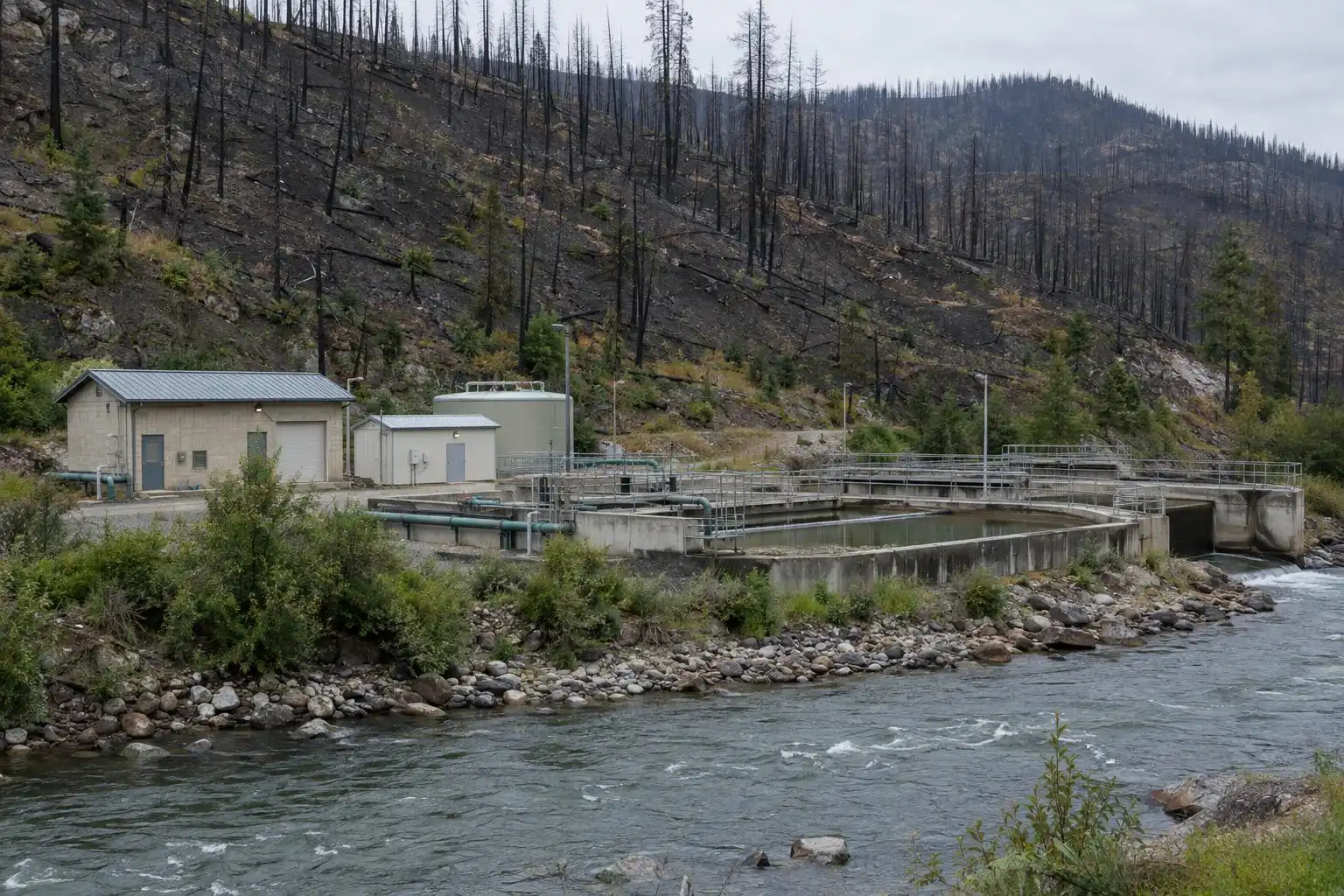

The flames can be out, the evacuation orders lifted, and the drinking-water emergency still ahead. When rain falls on a burned watershed, it can carry ash, sediment and other contaminants into the streams that supply a town. A treatment plant built for yesterday’s water may struggle with what arrives after the fire.
That is not a hypothetical problem. In Las Vegas, New Mexico, the 2022 Hermits Peak/Calf Canyon Fire contaminated the Gallinas River. Residents went without reliable water for months, and the city has relied on bottled water and deliveries from other communities while seeking funds for a new treatment plant. Research reported by the Associated Press suggests that some post-fire effects on water quality can last more than a decade.[1]
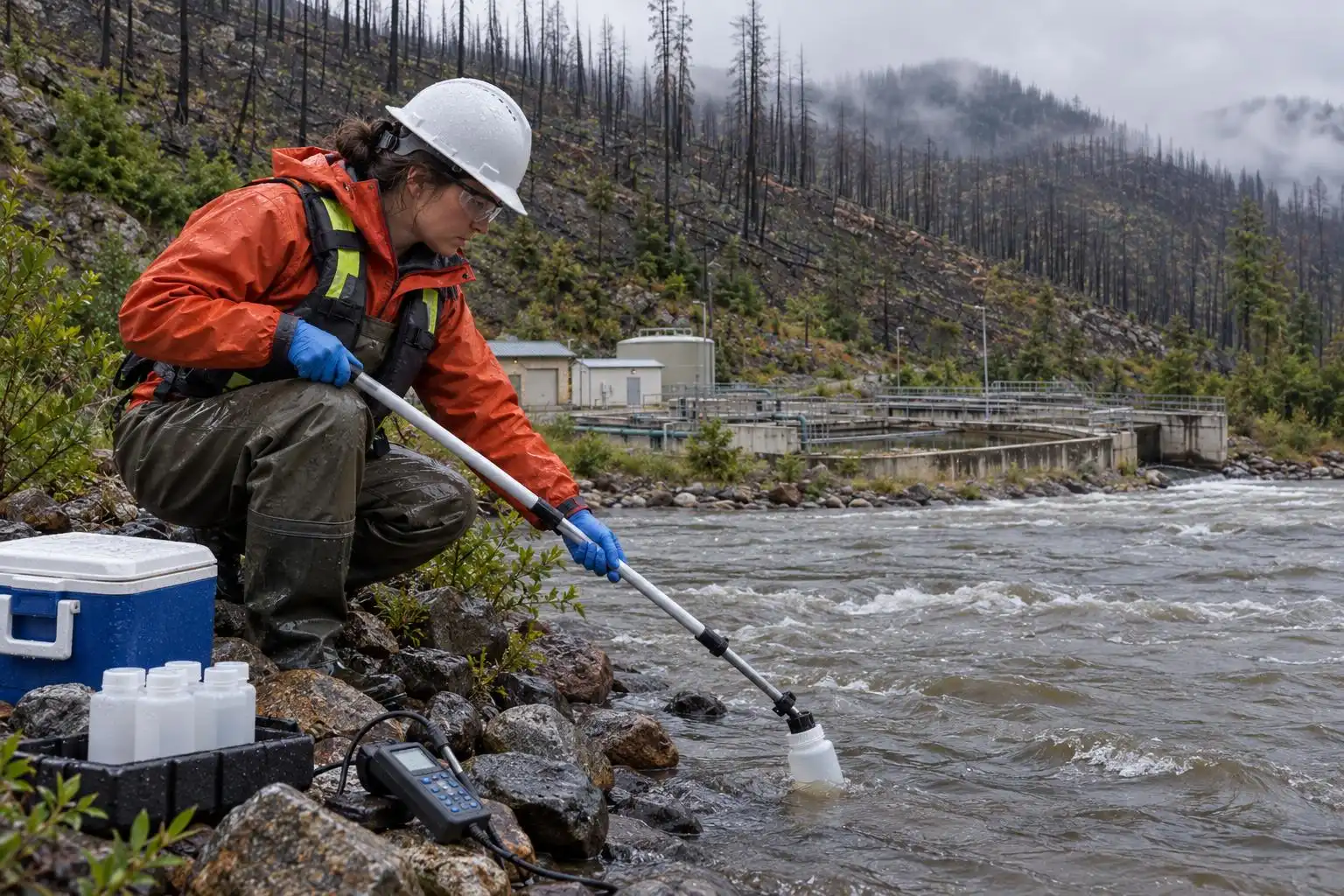
The emergency does not end at containment
A burn scar changes how a watershed behaves. Vegetation that once slowed runoff is gone; exposed soil is easier to move. A storm can send a pulse of muddy water toward a reservoir or intake just when crews are turning their attention from firefighting to recovery. The exact contamination depends on what burned and where, but utilities cannot assume that their usual treatment process will handle every post-fire surge.
This makes the first rainy season a critical test. It also makes the years afterward a budgeting problem. If water quality remains unstable, a utility may need more frequent sampling, additional treatment, alternate supply agreements and repeated public notices. Those costs sit alongside repairs to roads and power lines—not instead of them.
Las Vegas shows the danger of treating temporary supply as a complete solution. Bottled water and trucked-in tanks can keep people going. They do not replace a dependable treatment plant, and a city cannot finance one on the timetable of the next storm.[1]
A warmer watershed is not a single-hazard watershed
Fire is only one pressure on western water systems. Colorado’s prominent glaciers thinned dramatically after exceptionally low snow and warm temperatures in 2026, according to research reported by AP. Those glaciers are not a substitute for the region’s much larger seasonal snowpack. Their losses are nevertheless a visible warning: water stored in mountain ice and snow is becoming less reliable under sustained warming.[3]
At the other extreme, destructive flooding can arrive before households have recovered from the last event. AP reported that a resident along Colorado’s Navajo River saw his home and outbuildings flooded twice in two weeks, leaving him to navigate damaged access roads and uncertain housing. The immediate question was not an abstract annual rainfall total. It was how to get home, what could be repaired and how long emergency assistance would last.[8]
These events should not be collapsed into one claim that every community faces the same risk. They do show why a water plan built around average conditions is too narrow. A utility must be ready for poor source-water quality, interrupted access and constrained supply—not just a dry year or a single flood.
Start with the intake, then follow the money
For a town that draws from a fire-prone watershed, the useful question is not whether it has a resilience plan. It is whether it can keep delivering safe water when that watershed burns. A practical review should identify:
- Which intakes, reservoirs and treatment processes are exposed to post-fire sediment and contamination.
- How water quality will be sampled after a fire and during later storms.
- Which backup supplies are available, for how long, and under what agreements.
- What treatment upgrades and temporary operations would cost—and who has authority to pay.
That last question is where many plans become less convincing. A backup connection needs engineering, an agreement with the neighboring supplier and money to operate it. Monitoring needs trained staff and laboratory capacity. A treatment upgrade needs financing before construction can begin. Naming those needs in a document does not fund them.
There is also work upstream. Where local conditions warrant it, watershed managers can prioritize fuel treatments around critical source areas and plan how to stabilize severely burned slopes. Such work cannot prevent every fire or storm. Its value is in reducing the chance that a predictable runoff event becomes an avoidable water shutdown.
Recovery needs a longer clock
At COP31 in November, Brazil presented a road map for moving away from fossil fuels. Cutting emissions remains essential to limiting future warming. But a transition road map does not, by itself, tell a small utility how to pay for sampling next spring or a treatment plant over the next several years.[7]
The right recovery clock is the one the watershed imposes, not the one set by a fire’s containment date. State and federal assistance should make room for sustained monitoring, interim supply and permanent treatment where they are needed. Local officials, in turn, should publish what their backup arrangements can actually deliver and what remains unfunded.
People can see a burned hillside. They cannot see whether the next storm will push a water plant past its limits. That is why the unglamorous work—testing, agreements, operators, capital funding—has to start before the taps run dry.
References
- Bigger and more-frequent wildfires threaten water supplies across the US — https://apnews.com/article/wildfires-drinking-water-contamination-7b99f1b2657c4b9d6ac3d6e07dcf8cbc
- Colorado’s glaciers thinned dramatically due to record low snow and heat in 2026 — https://apnews.com/article/glaciers-melt-climate-change-colorado-0dd833f733e49fd9393cfa79cbc28fb5
- Brazil presents road map away from fossil fuels and toward renewable energies at UN climate talks — https://apnews.com/article/climate-cop31-turkey-fossil-fuels-renewable-energy-1a76dbefe56039c8841e9aeb49468048
- Uninsured and flooded out, a Colorado man worries if life will be normal again — https://apnews.com/article/flooding-weather-southwest-fema-four-corners-6133ba92b4bf347f90ab91657ee91477


Leave a Reply
You must be logged in to post a comment.