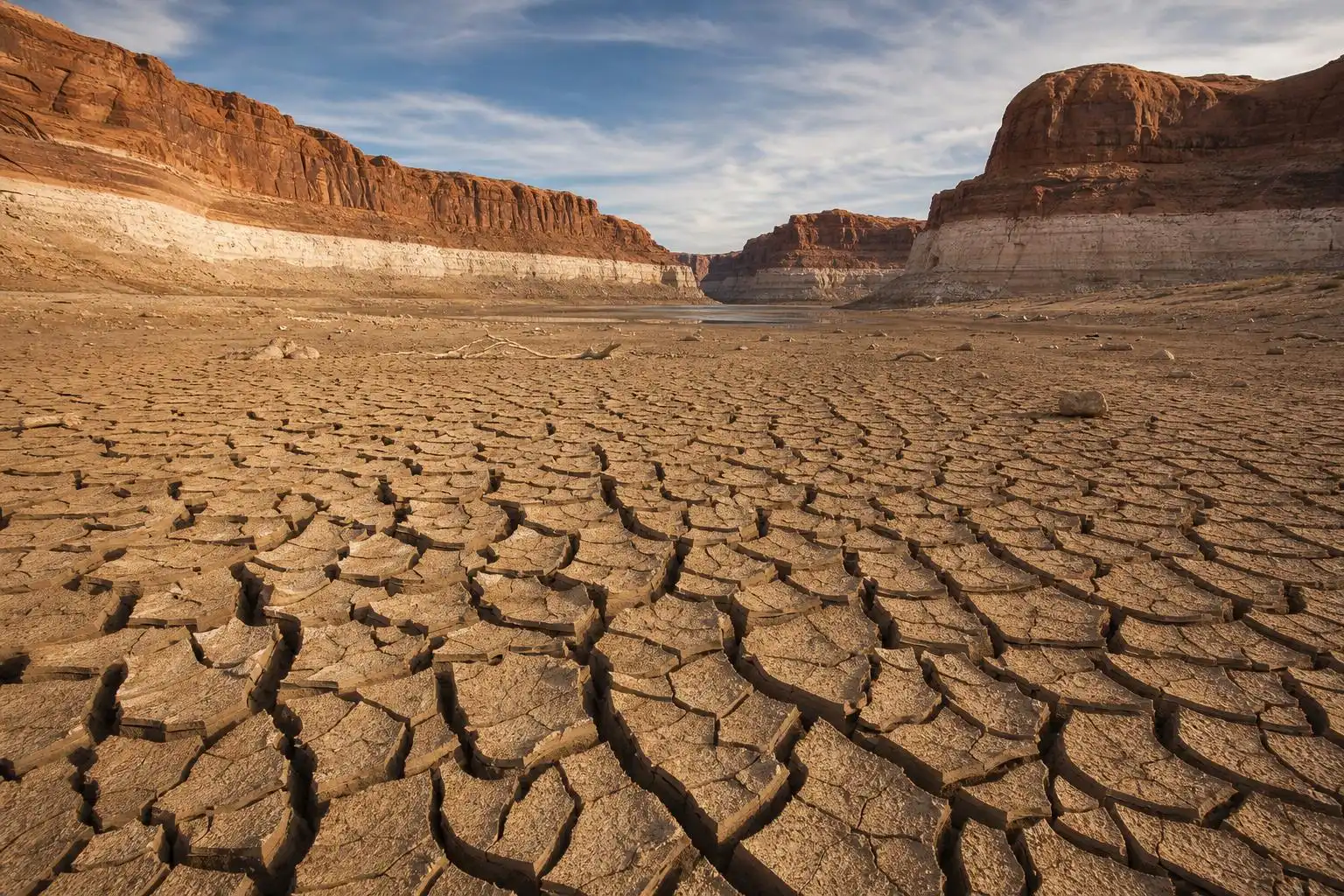

The word “megadrought” started appearing in news headlines a few years ago, and if you live anywhere in the American West, the Southwest, or parts of the Mediterranean, southern Africa, or southeastern Australia, you may have read it and felt a quiet dread settle in. Is that what’s coming for me? Is it already here? Will my kids grow up somewhere that can’t support them?
Those are fair questions, and they deserve a real answer — not reassurance that papers over the hard parts, and not catastrophizing that leaves you paralyzed. So let’s follow the question all the way down: what a megadrought actually is, how scientists know one is underway, what it means for the water that comes out of your tap, and what the honest uncertainty looks like.
What “Megadrought” Actually Means
A drought is a shortage of water relative to what a place normally expects. A megadrought is a drought that lasts at least two decades — not a bad dry year, not even a bad dry decade, but a generation-long reorganization of how much water a region receives and retains. The term comes from paleoclimatology, the science of reading past climates from tree rings, lake sediments, and cave formations. Researchers found evidence in those records of droughts in North America that lasted 20, 30, even 50 years before European settlement, disrupting civilizations that had no industrial water infrastructure to fall back on.
The reason this matters right now is that a 2022 study in the journal Nature Climate Change, led by UCLA researcher Park Williams, concluded that the drought gripping the American West since 2000 is already the driest 22-year period in at least 1,200 years — and that roughly 42 percent of its severity is attributable to human-caused warming rather than natural variability alone. In other words, this isn’t just a bad swing of the climate pendulum. Warming temperatures are evaporating more moisture from soil and snowpack, drying out the land even in years when precipitation is near normal.
The Snowpack Problem Nobody Talks About Enough
Most people think of drought as a rain problem. It is partly that, but in the mountainous West — and in many other regions that depend on mountain ranges as natural water towers — the deeper crisis is about snow.
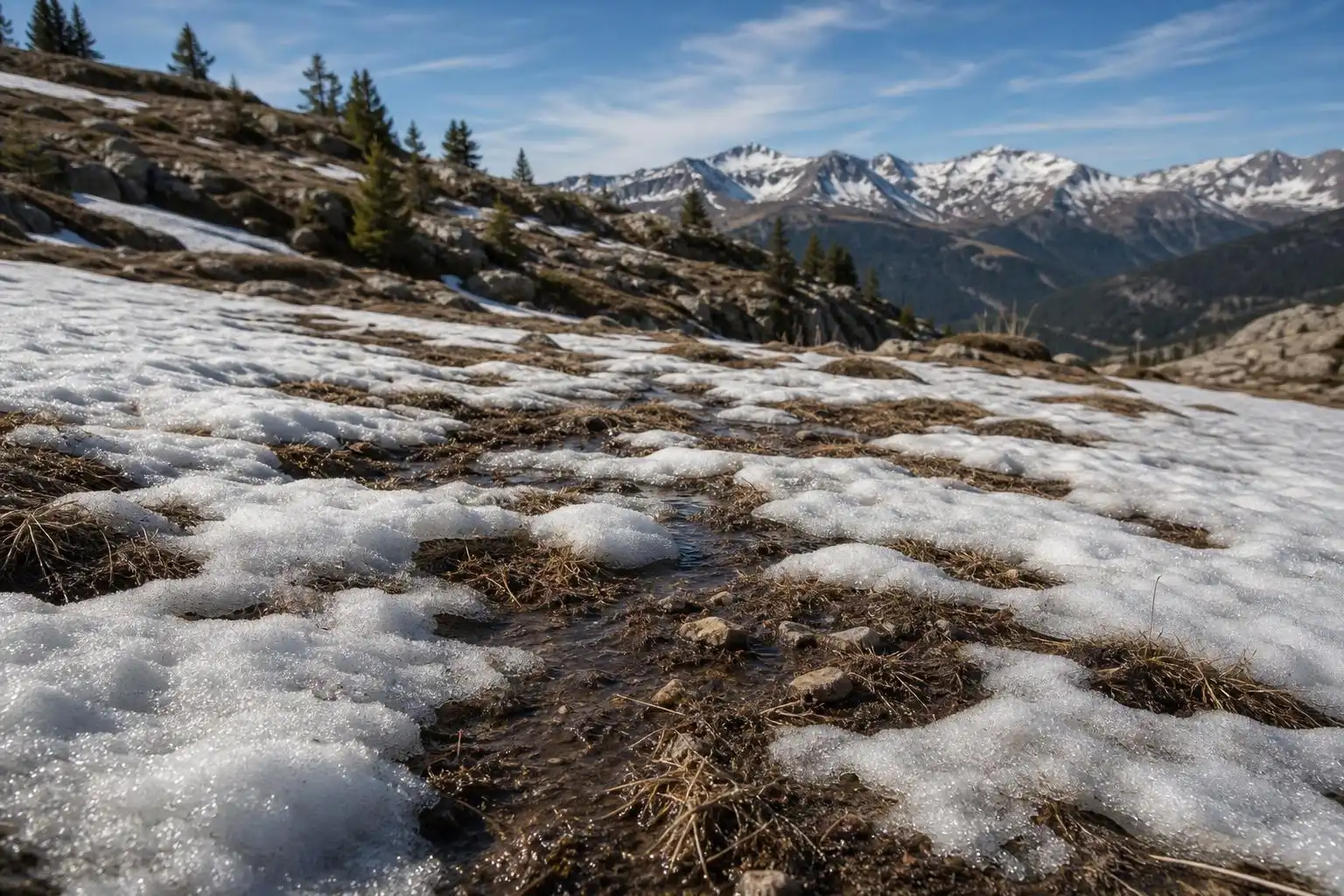
Snowpack acts as a reservoir. Snow falls through the winter, sits in the mountains, and melts slowly through spring and early summer, releasing water into rivers and streams right when farms and cities need it most. That timing is everything. When temperatures warm, two things go wrong simultaneously: more winter precipitation falls as rain instead of snow, and the snow that does accumulate melts earlier in the season. The result is a flood of water in February or March when reservoirs may already be full, followed by a parched summer when the rivers that normally run cold and clear are running low and warm.
The Colorado River, which supplies water to about 40 million people across seven states and parts of Mexico, has lost roughly 20 percent of its average flow since the early 20th century. Lake Mead, the largest reservoir in the United States, dropped to its lowest level on record in 2022 — low enough to expose previously submerged boats, shoreline facilities, and other infrastructure. These aren’t abstract statistics. They are the physical infrastructure of daily life becoming less reliable.
Does This Mean My Tap Goes Dry?
Here is where I want to be careful, because the honest answer is: it depends enormously on where you live and how your local water system is managed, and the range of outcomes is genuinely wide.
If you are in a city that draws primarily from a large reservoir system fed by mountain snowpack — think Phoenix, Las Vegas, Los Angeles, Salt Lake City, Tucson — you are already living with water managers who are watching these trends very closely and making difficult decisions about allocation, conservation mandates, and long-term supply contracts. The risks are real, the planning is active, and the outcomes will depend heavily on political choices made over the next decade about agriculture (which uses roughly 70–80 percent of the West’s developed water), groundwater extraction, and infrastructure investment.
If you are in a smaller rural community that relies on a local well or a small surface water source, your situation can be more precarious, because you have less redundancy and less financial capacity to build alternatives. Parts of the San Joaquin Valley in California have seen domestic wells go dry during drought years, and residents there have had to rely on bottled water and emergency deliveries. This is not a distant future scenario — it has already happened.
If you live in the eastern United States, Europe, or other regions not currently in megadrought conditions, your water risks look different. They are more likely to involve flooding, contamination of water supplies during extreme rainfall events, or localized drought in specific summers — serious, but not the same structural long-term threat. The honest answer is that not every place faces the same risk, and conflating all drought news into one global crisis narrative actually makes it harder to understand your specific situation.
How Scientists Know This Isn’t Just a Natural Cycle
This is a question worth sitting with, because it’s reasonable to ask. Droughts happened before humans burned fossil fuels. The paleoclimate record shows that. So how do researchers distinguish a natural swing from something we’ve pushed into being?
The short answer is that they look at the fingerprints. Natural droughts are driven primarily by changes in sea surface temperatures and atmospheric circulation patterns — phenomena like La Niña, which tends to reduce winter precipitation across the Southwest. Those patterns do produce dry years and even dry decades. But the current drought is drier than any comparable period in 1,200 years even accounting for those natural drivers. The extra drying signal — the part that pushes this drought beyond anything in the historical record — lines up with the warming trend in a way that natural variability alone doesn’t explain.
This is the kind of attribution work that climate scientists do carefully and with explicit uncertainty ranges. The 42 percent figure I mentioned earlier comes with error bars; the range in that study runs from about 19 to 67 percent. That’s a wide range, and it’s honest. It means we can say with confidence that warming is making this significantly worse, while acknowledging that we can’t pin down the exact fraction to a decimal point. That uncertainty is not a reason to dismiss the finding — it’s a reason to take the whole range seriously.
What You Can Actually Do With This Information
I’m not going to tell you to take shorter showers and feel good about it. Individual water conservation matters at the margins, and if your utility is asking you to cut back, please do — it genuinely helps balance local supply during crises. But the structural water challenges of a warming climate will be solved or not solved at the level of policy, infrastructure, and agricultural economics, not at the level of individual faucets.
What you can do, concretely, is understand your own water system. Most utilities in the United States publish annual water quality and supply reports. Find yours. Look at where your water comes from, how much storage your system has, and whether your utility has a drought contingency plan. That knowledge is genuinely useful — both for your own planning and for being an informed participant in local decisions about water rates, conservation rules, and infrastructure bonds.
If you have children and you’re wondering what to tell them: the honest version is that water is going to require more care and more attention than it did for previous generations, and that the places people live and the ways they grow food are going to shift over the coming decades. That’s not a reason for despair. Humans have always moved and adapted in response to environmental change. What’s different now is that we have enough scientific understanding to see it coming and make choices ahead of time rather than just reacting to crisis.
The Part That’s Still Genuinely Uncertain
I want to end here, because I think it’s important. The trajectory of warming — and therefore the trajectory of drought severity — is not fixed. The difference between 1.5 degrees Celsius of global warming and 3 degrees is enormous in terms of what happens to snowpack, river flows, and the frequency of the extreme heat events that accelerate soil drying. Those temperature outcomes depend on decisions being made right now about energy systems, land use, and policy.
This means that megadrought is not a fate. It is a risk whose severity is still being determined. The Southwest entered a megadrought-scale dry period, and some of the underlying aridification risk is locked in for years to come because of warming that has already happened. But how bad the second half of this century looks depends on choices that are genuinely still open. That’s not false hope — it’s the actual shape of the situation, and I think you deserve to know it clearly.
Your tap is probably not going dry tomorrow. But the system that fills it is under real, measurable stress, and paying attention to that — locally, politically, practically — is one of the most grounded things you can do.


Leave a Reply