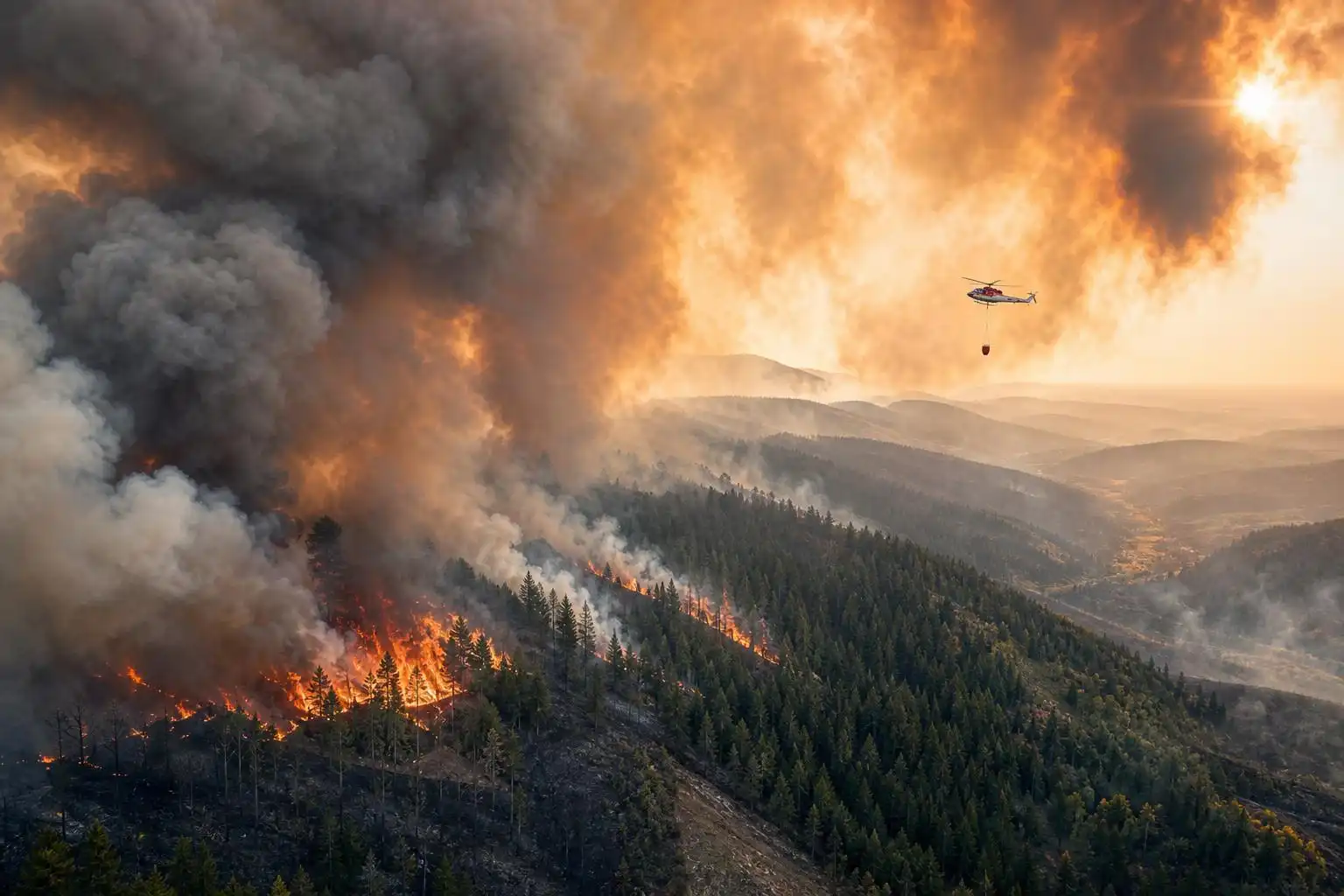

It is August 2026, and the world is on fire. Not metaphorically — literally. Spokane is smoldering. Southwestern France has lost an area four times the size of Paris to flames. Serbia is deploying military helicopters over the Deliblato Sands. A British Columbia resident was forced to evacuate with his goats. Greece lost two firefighters on Crete. And across Latin America, governments are watching El Niño strengthen and bracing for what comes next.
This is not a bad year. This is the compounding result of decades of deferred action — on fuel treatments, on building codes, on water infrastructure, on land-use policy — arriving all at once, on every continent, simultaneously.
I want to talk about what that actually means for the people doing this work.
The Ignition Problem Is Not Just About Arson
The Spokane fires are going to generate a lot of coverage about the man who was arrested and charged with deliberately setting the Old Trails Fire — a man who, according to police, spent weeks researching weather conditions to find the optimal day for ignition: hot, windy, low humidity.[2] That story is genuinely alarming. But it is also a distraction from the harder conversation.
Arson is a crime. Climate change is a structural condition. The arsonist in Spokane didn’t create the drought, the beetle-killed timber, the decades of fire suppression that loaded the landscape with fuel, or the housing developments that pushed into the wildland-urban interface without adequate defensible space. He found a landscape that was ready to burn and lit a match. The result: roughly 850 buildings destroyed and approximately 67,000 people evacuated.[7]
The question planners need to ask is not just “how do we catch arsonists?” It’s “why was this landscape so catastrophically ready to burn?” And the answer to that question leads directly to fuel treatment backlogs, suppression-first fire management culture, and the political difficulty of doing prescribed burns near communities that don’t want smoke.
Europe Is Not Prepared for This, and the Balkans Are Proof
Serbia’s wildfire crisis is unfolding in the Deliblato Sands — a sandy, semi-arid region in the northeast of the country that has historically been managed as a nature reserve. Military helicopters are now battling fires there while multiple other blazes burn simultaneously across the country.[1]
But here is the detail from that same situation that I think deserves far more attention than it is getting: Hungary’s Paks Nuclear Power Plant — the country’s only nuclear facility — was forced to reduce output to roughly 10% of normal production because the Danube’s water levels dropped too low to support adequate cooling.[1] The Hungarian government then had to ask businesses and citizens to cut electricity use during peak hours.
Read that again. A drought-driven heat wave simultaneously increased electricity demand (everyone running air conditioning) while disabling a major source of electricity generation. That is a cascading infrastructure failure. That is the kind of compound risk that most European grid operators have modeled but few have operationalized a real response to.
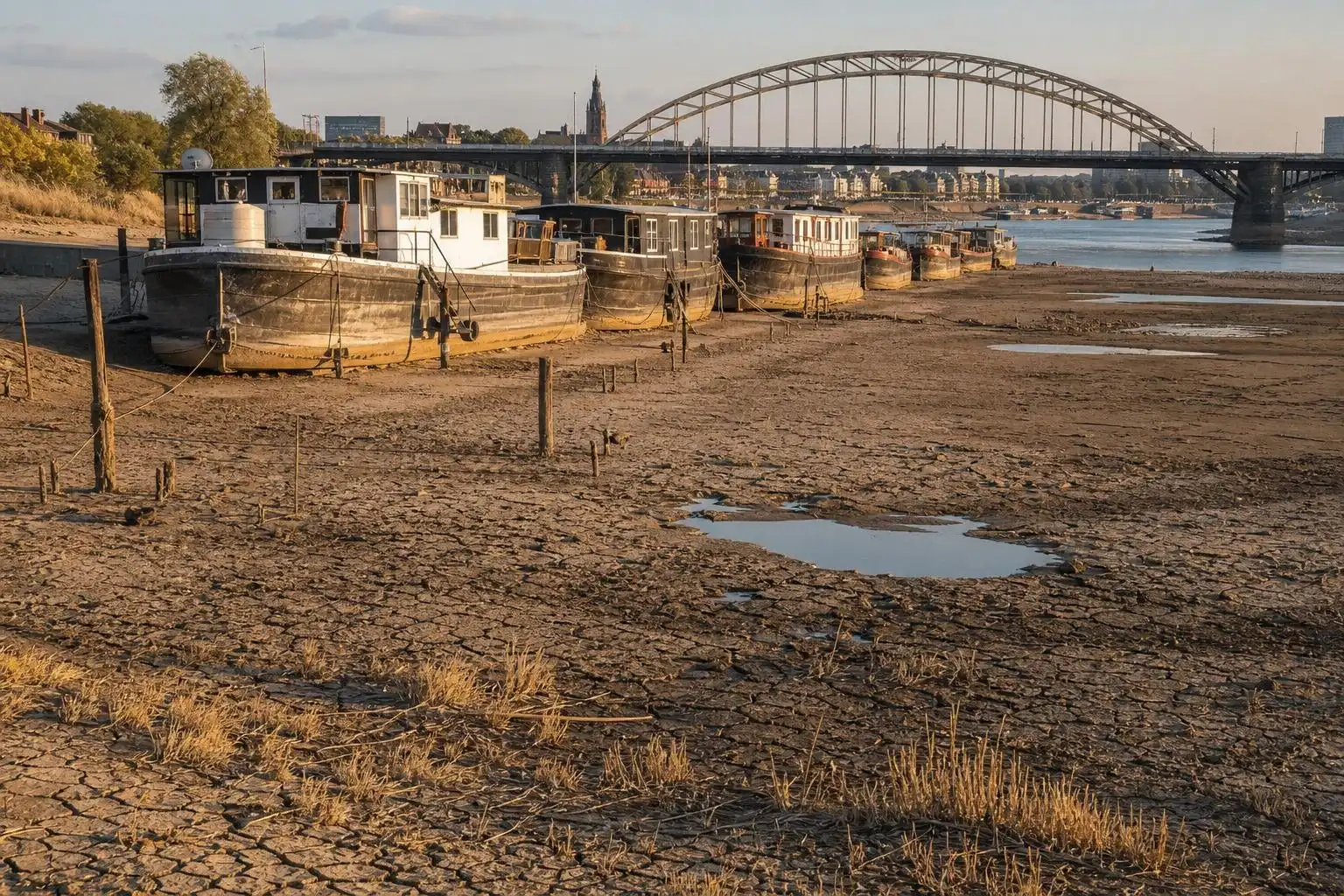
Meanwhile, the Rhine and the Danube are at record low levels, Dutch dike inspectors are finding drought-induced cracks in water defenses that have protected low-lying communities for centuries, and river trade in Germany has been severely disrupted.[4] These are not isolated events. They are a single, interconnected system failure.
France and the Accounting of Loss
Southwestern France got some relief in late July when cooler temperatures and humidity moved in after wildfires charred an area four times the size of Paris.[8] The relief was real and welcome. But I want to be careful about how we frame that kind of news.
“Rain arrives, firefighters get a break” is a true headline. It is also a headline that allows us to exhale, move on, and not reckon with what just happened. An area four times the size of Paris burned. That is not a statistic to absorb and move past. That is old-growth forest, agricultural land, wildlife habitat, carbon storage, and in many cases, people’s homes and livelihoods — gone.
The pattern of “crisis, brief relief, crisis forgotten” is one of the most dangerous features of how wealthy countries respond to climate disasters. The relief becomes the story. The structural vulnerability that made the crisis possible stays intact, fully loaded, ready for next summer.
The Western US: Heat Domes and the Infrastructure We’re Not Building
The heat dome that gripped the Western United States from Arizona to Montana in late July and early August 2026 — driving temperatures to record highs and pushing wildfire risk to critical levels across states that were already burning[5] — is a stress test for systems we have not upgraded.
Cooling centers are underfunded and understaffed. In many Western cities, the people most at risk from extreme heat — elderly residents, outdoor workers, people without air conditioning — still lack reliable access to cooling. Power grids strain under the load of millions of air conditioners running simultaneously, which is exactly when they are most likely to fail.
Meanwhile, wildfires burning across the western US and Canada[6] are not just destroying homes — they are destroying the watersheds that supply drinking water to downstream communities, the transmission corridors that carry power, and the roads that serve as evacuation routes. The interdependencies are real and they are not adequately mapped in most municipal hazard mitigation plans.
Latin America Is Watching and Has a Narrow Window
Across Latin America, governments are mobilizing as El Niño strengthens — activating contingency plans, repositioning firefighting resources, and preparing water and energy systems for what is expected to be a difficult period of drought, extreme heat, and flooding.[3]
The World Meteorological Organization’s Rodney Martinez put it plainly: “Now is the time for decisions, for effective preparedness and the political consistency to really be proactive this time.”[3]
That phrase — “this time” — carries a lot of weight. It implies that previous times, the political consistency wasn’t there. The mobilization happened and then evaporated when the immediate crisis passed. That is the pattern we need to break, and breaking it requires something more durable than emergency response: it requires institutionalized, funded, multi-year adaptation programs that survive election cycles.
What Actually Works (And What It Costs)
Let me be direct about what the evidence from wildfire-prone regions tells us about effective mitigation, because this is where most public discourse goes soft.
Fuel treatments work — but only at scale and only if maintained. Prescribed burns, mechanical thinning, and managed grazing can meaningfully reduce fire intensity in treated areas. But a 500-acre treatment in a 500,000-acre landscape is not a solution. It’s a demonstration project. The scale of treatment needed to make a landscape-level difference requires sustained annual budgets, trained crews, and permitting processes that don’t take three years per project.
Building codes save lives and structures — but only where they’re enforced. Ember-resistant vents, Class A roofing, and defensible space requirements are not new ideas. They are proven. The problem is that they are frequently watered down during the permitting process, inconsistently enforced, and not retroactively applied to the existing housing stock that constitutes the vast majority of structures in the wildland-urban interface.
Water infrastructure is not optional. The Hungary nuclear plant story is a preview. As drought intensifies, the assumption that water will be available for cooling, firefighting, agriculture, and drinking — simultaneously — is going to break down in more places. Water allocation frameworks need to be updated now, before the crisis, not during it.
Managed retreat is the conversation no one wants to have. Some places should not be rebuilt after they burn. Some communities are in locations where the combination of fire risk, water scarcity, and extreme heat makes long-term habitation increasingly untenable. This is politically explosive and practically complicated, but it is also, in some cases, the honest answer. Pretending otherwise is not compassion — it is setting people up for repeated loss.
The Gap Between a Plan and a Funded Plan
Every city and region I have ever worked in has a climate adaptation plan. Most of them are good documents. Many of them are sitting on a shelf, or on a website, or in a drawer in a planning department, waiting for the funding that was never appropriated, the staff that was never hired, the political will that evaporated after the last election.
The summer of 2026 is not going to fix that gap by itself. Disasters rarely do. What they do, if we let them, is create a brief window of political attention in which the gap becomes visible to people who normally don’t think about it.
The question is whether practitioners, advocates, and policymakers use that window to push for the structural changes — the funded fuel treatment programs, the updated building codes, the water allocation reforms, the honest conversations about managed retreat — or whether we spend it on press conferences, emergency declarations, and GoFundMe pages for people who lost everything.
The fires will go out. The drought will eventually break. The heat dome will move on. The question is what we build — or fail to build — in the time between.
References
- Serbia races to contain wildfires as Europe’s blistering heat wave grips the Balkans – AP News — https://apnews.com/article/serbia-europe-heat-wave-wildfires-drought-e917163758ae90c94c8d0cd8f17c7e10
- Man charged with arson in Spokane, Washington, told police he planned wildfire for weeks – AP News — https://apnews.com/article/wildfires-spokane-washington-suspect-arson-charges-f9e3d98df0c20a16d2f9b083efd99ab3
- Latin American governments prepare for El Nino as drought, floods and heat loom – AP News — https://apnews.com/article/el-nino-preparations-latin-america-climate-energy-transport-water-drought-67500aefa69ca35a067bc24628168c26
- Dry, hot summers are putting Dutch dikes at risk and threatening German river trade – AP News — https://apnews.com/article/netherlands-drought-water-dikes-climate-6eb8910dabc77f2fe962ac5aad638347
- Heat wave brings record-breaking temps, heightened wildfire risk to parts of Western US – AP News — https://apnews.com/article/west-heat-dome-climate-594390d448a480564ec7db6b15b5fffc
- Wildfires burn across western US and Canada as residents are evacuated – AP News — https://apnews.com/article/western-wildfires-canada-us-946f5599db59517cb88fd3f0df9f5c46
- Firefighters get a handle on Spokane wildfires as tens of thousands remain evacuated – AP News — https://apnews.com/article/wildfire-arson-spokane-evacuation-arrest-3738a2f795ca9cc0cca93eae76fb7ff0
- Cooler weather and potential rain move into the French region torched by wildfires – AP News — https://apnews.com/article/france-spain-greece-wildfires-heat-climate-change-de0bfabe2249153afc0e16da2f7e02f3



Leave a Reply