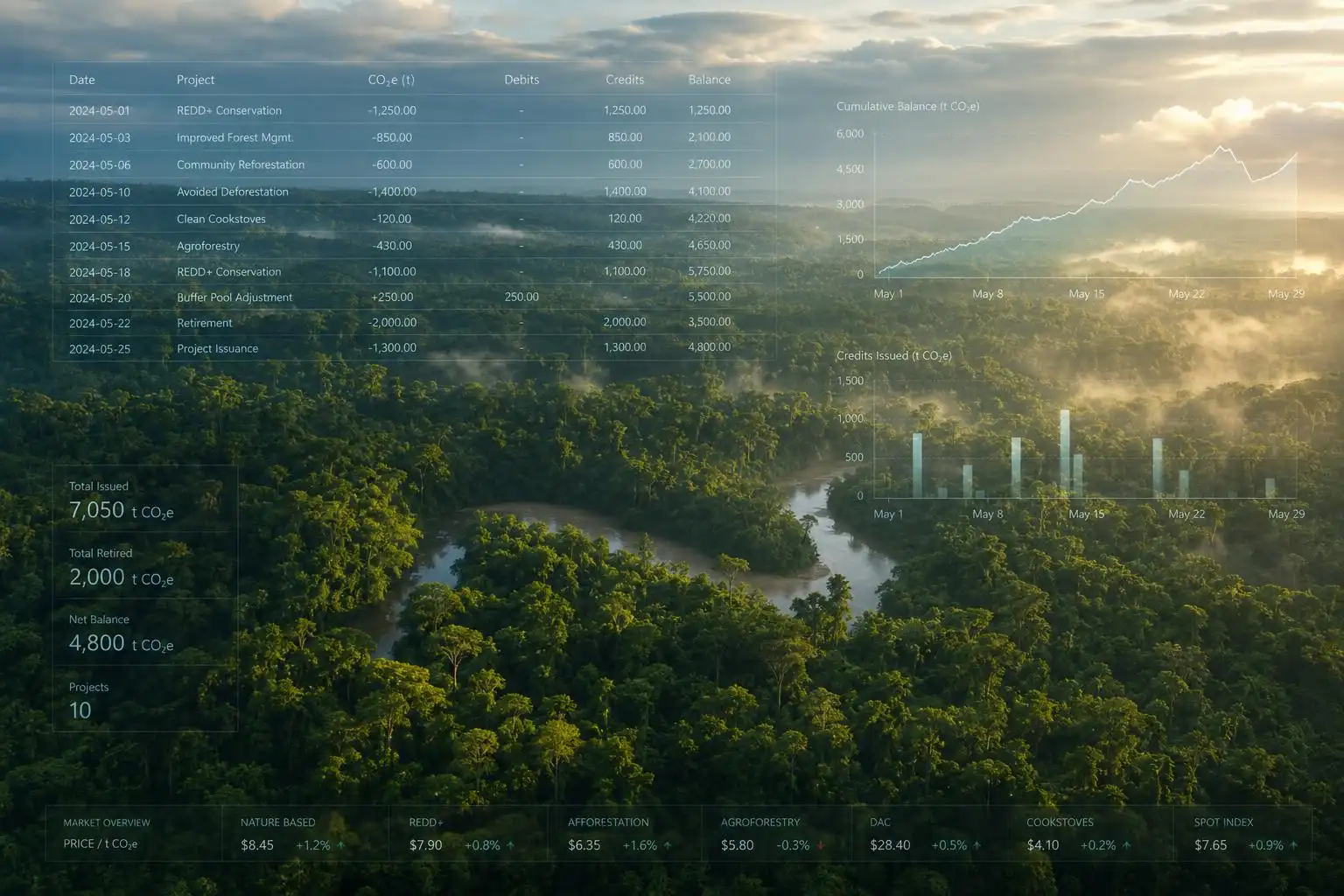

Every year, corporations announce net-zero commitments backed by portfolios of carbon offsets. Every year, audits quietly reveal that a significant fraction of those offsets never removed — or even avoided — the emissions they claimed to. The gap between what offsets promise and what they deliver is not a rounding error. It is, in many cases, the entire point of the accounting.
Let me explain why, starting with a distinction that should be elementary but is routinely blurred: removal is not the same as avoidance.
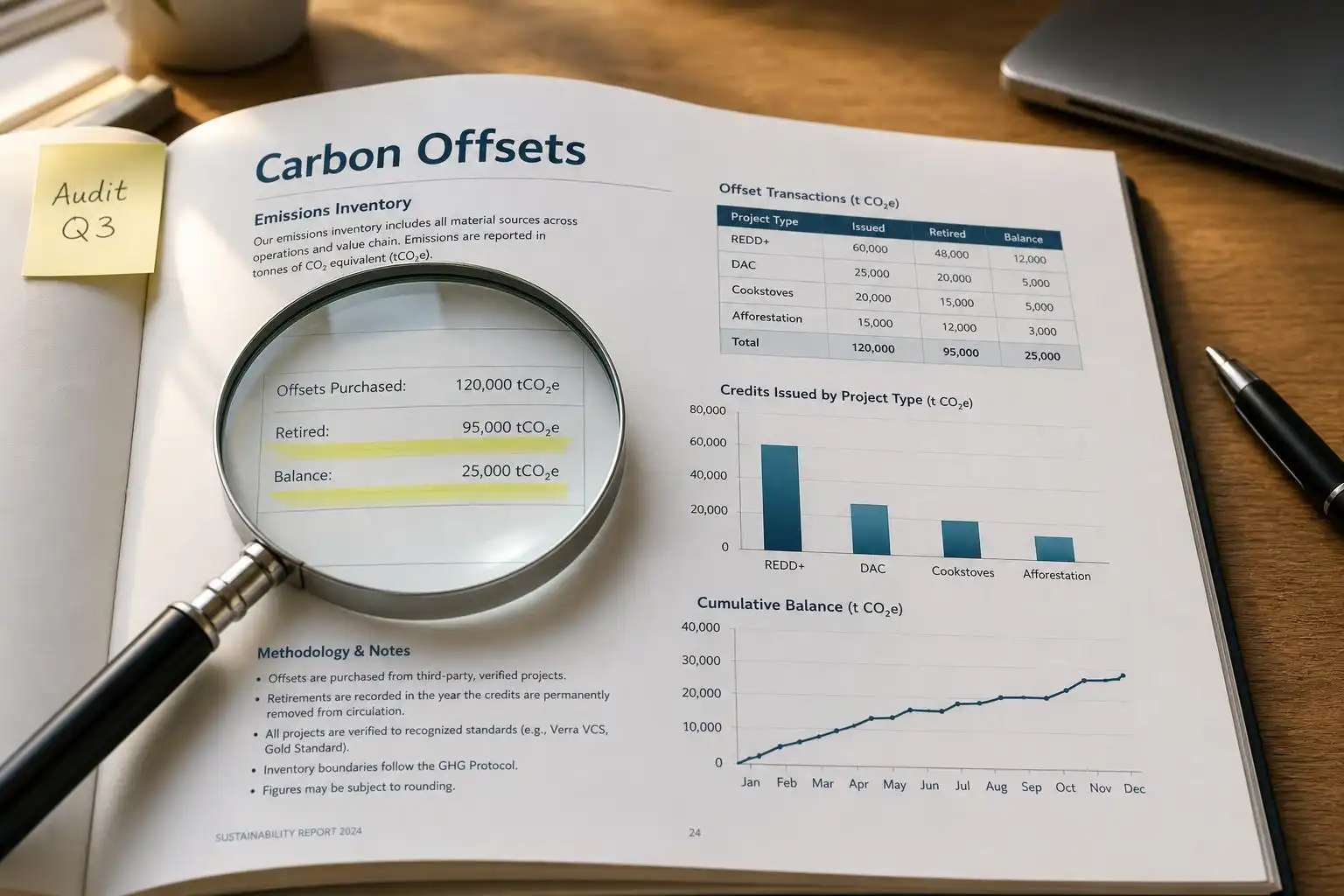
Two Very Different Things
A carbon removal credit represents CO₂ that has been physically extracted from the atmosphere and stored somewhere — in a forest, a soil profile, a geological formation, a mineralized rock. A carbon avoidance credit represents an emission that did not happen, typically because a project funded something cleaner than what would otherwise have occurred: a cookstove instead of an open fire, a protected forest instead of a logged one.
Both sound reasonable. The problem is that avoidance credits require you to know, with confidence, what would have happened in the absence of the project. This counterfactual — called the baseline — is where carbon accounting goes to die.
The Baseline Problem
Take avoided deforestation, which makes up a large share of the voluntary carbon market. To issue credits, a project must demonstrate that the forest it protects would have been cleared without the funding. That requires projecting a deforestation rate into the future. Those projections are, almost universally, too high.
A landmark 2023 analysis of REDD+ projects — the dominant framework for forest carbon offsets — found that the vast majority of projects studied had dramatically overestimated the threat to their forests. One review, published in Science, examined 26 projects and found that on average they had issued roughly ten times more credits than the actual emissions reductions they achieved. Not ten percent off. Ten times.
The incentive structure explains this perfectly. Project developers are paid per credit issued. Regulators are distant and under-resourced. The certifying bodies — Verra, Gold Standard, and others — are funded by the very projects they certify. The baseline gets inflated because everyone in the room benefits from inflation.
Permanence: The Problem That Doesn’t Go Away
Even when a credit represents a genuine reduction, there is a second question: does it last?
Carbon stored in forests is not stored permanently. Forests burn. Beetles kill trees. Droughts stress ecosystems. A forest offset issued in California in 2015 might be releasing its carbon right now in a wildfire. The standard industry response is a “buffer pool” — a reserve of unissued credits set aside to cover reversals. But buffer pools are sized based on historical risk, and climate change is systematically shifting that risk upward. What was a one-in-a-hundred-year fire regime is becoming a one-in-ten-year fire regime. The math does not hold.
Geological storage — pumping CO₂ underground into basalt or saline aquifers — is genuinely more permanent, but it is expensive, rare, and represents a tiny fraction of the current market. The credits that are cheap enough to be attractive are, almost by definition, the ones with the worst permanence profiles.
Additionality: Would It Have Happened Anyway?
The third pillar of a credible offset is additionality: the project must not have happened without carbon finance. This is another counterfactual, and it fails in predictable ways.
Renewable energy projects in markets where renewables are already cost-competitive frequently claim additionality they do not have. A solar farm in Texas that would have been built regardless of offset revenue is not adding anything to the climate ledger. It is simply double-counting a transition that was already underway. Studies of Clean Development Mechanism (CDM) projects — the predecessor to the current voluntary market — found that somewhere between one-third and two-thirds of credits issued failed additionality requirements. There is no reason to believe the voluntary market has substantially improved on this record.
What the Carbon Cycle Actually Tells Us
Here is what I find most clarifying: the atmosphere does not care about accounting. It responds to concentrations.
When a company emits a tonne of CO₂ and purchases an offset, the net effect on atmospheric CO₂ depends entirely on whether that offset represents a real, additional, permanent removal or reduction. If it does not — and the evidence suggests most do not — then atmospheric CO₂ is higher than the accounting says it is. The planet warms a little more. The offset was a bookkeeping entry, not a physical intervention.
The carbon cycle has no line item for “promised but undelivered.” It integrates every molecule that actually enters or leaves the atmosphere. Our accounting systems need to do the same.
The Quiet Harm of Bad Offsets
Beyond the direct accounting failure, low-quality offsets cause a subtler harm: they allow companies to defer genuine emissions reductions. If a corporation can purchase cheap avoidance credits for $5 per tonne, it has little incentive to invest in the $80-per-tonne engineering required to actually decarbonize its operations. The offset market, in this way, can function as a mechanism for delaying the transition it claims to support.
This is not a hypothetical. Airlines have used offsets as their primary climate strategy for years. Oil majors have announced net-zero targets built almost entirely on nature-based offset portfolios. These are not serious decarbonization plans. They are serious public relations plans.
What Would Actually Work
None of this means that carbon markets are irredeemable, or that nature-based solutions have no role. Forests matter enormously to the carbon cycle — they absorb roughly 30% of annual anthropogenic CO₂ emissions. Protecting and restoring them is genuinely important. The problem is using that importance as a license to issue credits that don’t reflect physical reality.
A credible offset market would require:
- Conservative, independently verified baselines with no financial relationship between the verifier and the project developer.
- Long-term monitoring with clawback provisions when carbon is released — credits cancelled, not just buffer pools drawn down.
- Strict additionality criteria that exclude projects in markets where the financed activity would have occurred anyway.
- A hard distinction between removal credits and avoidance credits, with removal credits treated as categorically more valuable for net-zero accounting purposes.
- Regulatory oversight with teeth — not voluntary certification by industry-funded bodies.
Until those conditions exist, the honest answer to “can I offset my emissions?” is: probably not in any meaningful physical sense. You can purchase a certificate. The atmosphere will not notice.
The math matters. The molecules matter. The accounting should match both.



Leave a Reply