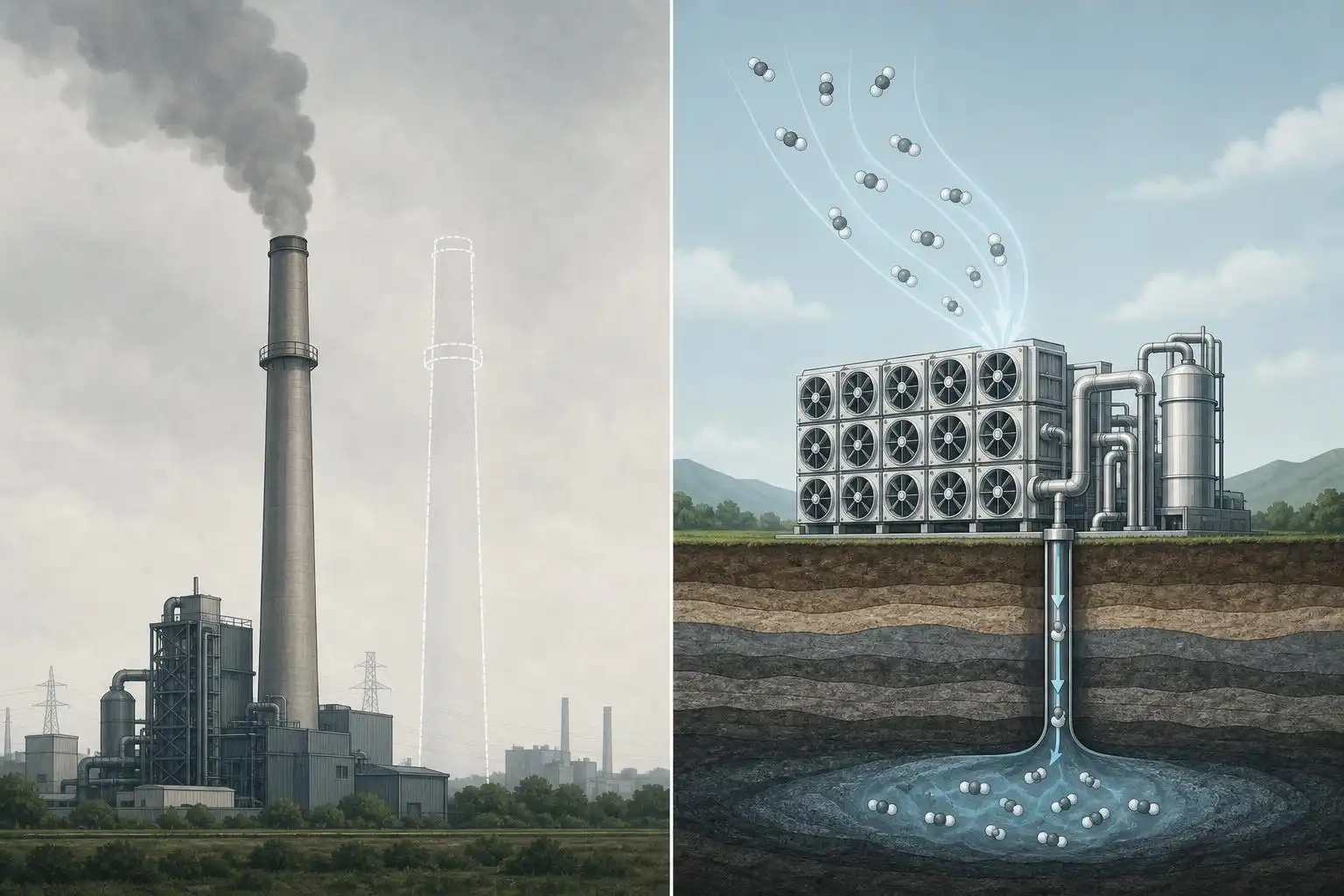

Every net-zero pledge rests on a single arithmetic operation: emissions minus removals equals zero. It sounds clean. In practice, the industry has spent two decades quietly substituting a third term into that equation — avoidance — and pretending it belongs on the same side of the ledger as removal. It does not. This is not a semantic quibble. It is the difference between a claim that is physically true and one that is an accounting fiction dressed up in the language of physics.
Start with what “net zero” actually requires at the level of the atmosphere. A molecule of CO2 emitted from a cement kiln or a jet engine joins a well-mixed global pool that persists, in meaningful fractions, for centuries. To offset that molecule’s warming effect, you need to either prevent an equivalent molecule from entering the atmosphere in the first place, or you need to pull an equivalent molecule back out and lock it away for a comparably long time. Only the second option is removal. The first is avoidance, and avoidance does something entirely different: it keeps a counterfactual emission from happening, which is valuable, but it does not touch the stock of carbon already accumulating overhead.

The Stock-Flow Confusion at the Heart of Most Registries
Carbon accounting has a stock-and-flow problem it refuses to name. Removals affect the atmospheric stock directly — a ton of CO2 drawn down via reforestation, enhanced weathering, or direct air capture is a ton physically extracted from the pool that’s warming the planet. Avoidance projects, by contrast, affect a flow that never happened: a forest that wasn’t cut down, a cookstove that burned less wood, a wind farm that displaced a coal plant that would otherwise have run.
The trouble is that most registries issue identical-looking credits for both. A ton is a ton on the certificate, regardless of whether it was drawn down from the atmosphere or merely kept out of it under a projection nobody can fully verify. I have written before about how thin the counterfactual baselines underneath avoidance credits tend to be — the forest that was “at risk” of logging, the cookstove adoption rate assumed absent the project. That thinness is a separate problem from the one I want to dwell on here: even a perfect, unimpeachable avoidance credit does not remove carbon. It just means one fewer ton was added. Those are not interchangeable inputs to a net-zero equation, no matter how convenient it is to treat them that way.
Why This Distinction Breaks Corporate Claims Specifically
Consider a company that emits one million tons of CO2 annually and buys one million avoidance credits — say, from a REDD+ forest-protection project — and calls itself net zero. Even granting the avoidance claim is real (a strong assumption), the company’s actual emissions have added a million tons of new carbon to the atmosphere. The registry has helped ensure that somewhere else, a million tons that might have been added weren’t. The atmosphere, however, does not do accounting by intention. It only tracks what actually entered it. Relative to a credible baseline, the avoidance project leaves the atmosphere with a million tons less than it would otherwise have — but the company’s own emissions still represent a million tons of new carbon added to the atmosphere, and the overall change in atmospheric stock depends on the sum of all emissions and sinks, not on this one transaction alone.
This is why “net zero” claims built primarily on avoidance credits should be read as “gross emitter, offset by counterfactual prevention elsewhere” — a true and useful thing to say, but not equivalent to zero. Genuine net zero, in the sense the term was coined to describe by climate scientists modeling pathways to stabilize temperature, requires that anthropogenic emissions be balanced by anthropogenic removals. Avoidance can and should slow the rate at which the problem grows. It cannot balance the books on emissions that have already happened.
Durability Is the Other Half of the Problem
Even legitimate removals are not all equal, and this is where the accounting gets genuinely hard rather than merely sloppy. A ton of carbon sequestered in a tree can in principle persist for centuries, but it carries a substantially higher reversal risk than geological storage — fire, disease, drought, or harvest can send it back into the atmosphere well before a comparable geological deposit would budge. A ton of CO2 injected into reactive basalt formations, where it gradually mineralizes into solid carbonate rock, is essentially permanent on any timescale that matters to a policy horizon. Treating these as fungible — one forestry ton equals one geological ton — is another quiet substitution that lets buyers claim durable removal while purchasing something considerably more fragile.
The IPCC’s own carbon-cycle work is explicit that the climate system cares about cumulative emissions integrated over time, which means a removal that reverses in thirty years is not equivalent to permanent removal, even if the initial drawdown numbers match. A rigorous net-zero claim has to specify not just “how many tons were removed” but “removed and held for how long, with what probability of reversal.” Almost no corporate disclosure does this. The number that gets published is the gross tonnage, stripped of the durability discount that any honest carbon-cycle accounting would apply.
What an Honest Ledger Would Require
None of this argues against avoidance projects; slowing deforestation and displacing fossil generation are legitimately valuable climate interventions and deserve their own accounting category, tracked and rewarded on their own terms. The argument is against laundering them into the same units as removal and calling the sum “net zero.” A defensible ledger would report gross emissions, removals (weighted by durability and reversal risk), and avoided emissions as three separate lines — not one blended number engineered to reach zero.
Until standards bodies enforce that separation, every “net zero by 2030” headline deserves the same question applied with the same skepticism: how much of this is atmosphere-touching removal, how much is a counterfactual story about a ton that was never going to exist, and how long is any of it actually expected to last? The math only works if you’re willing to not ask. Once you ask, most net-zero claims stop summing to zero and start summing to a number a great deal larger, and considerably more honest.



Leave a Reply