
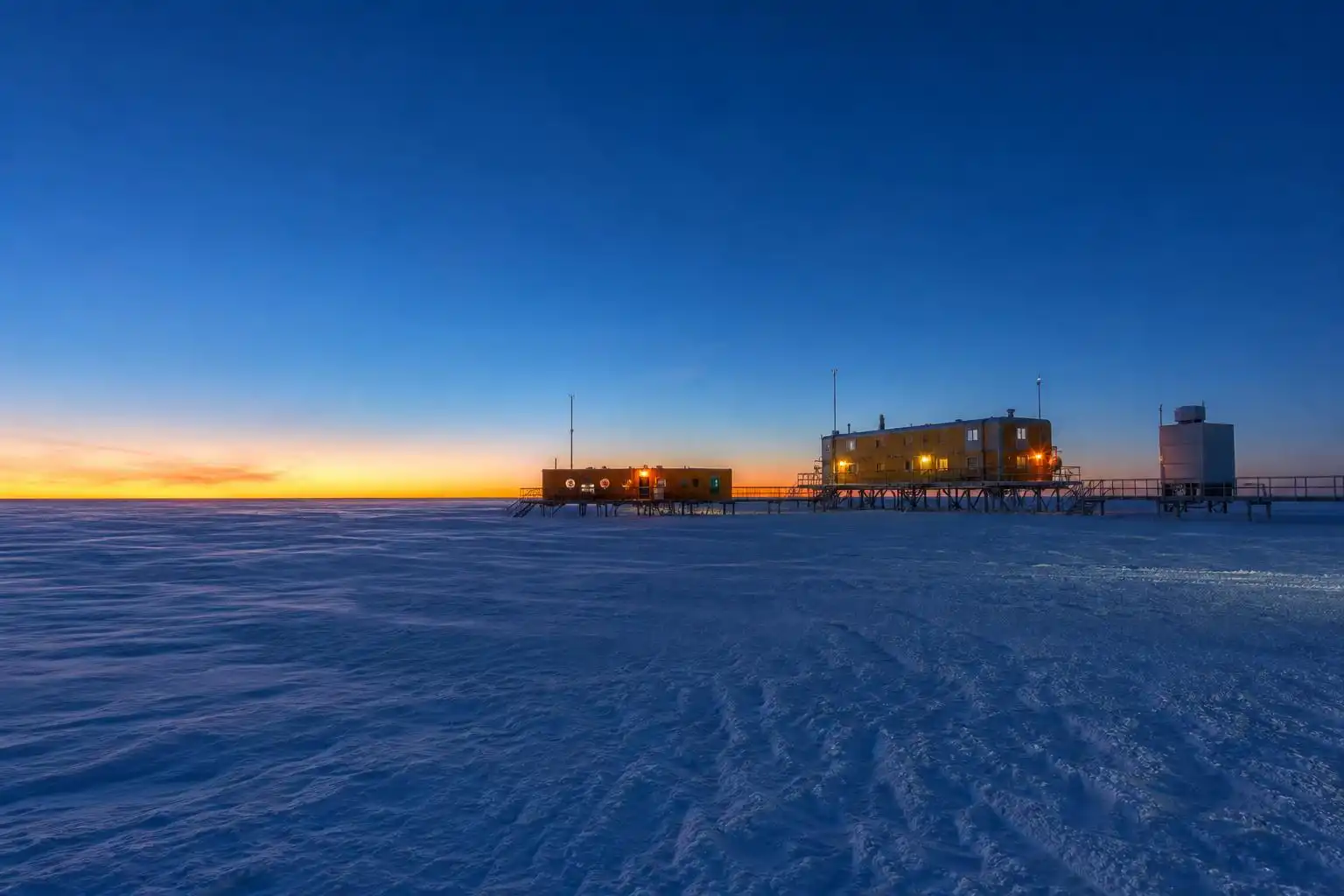
The drill site at Dome C, Antarctica, sits at 3,233 metres above sea level, where the air is so thin and dry it feels like breathing through a cotton cloth. At night, the temperature drops to minus forty and the stars are absurdly bright — no moisture, no dust, nothing between you and the universe. It is, in many ways, the least hospitable place on Earth. It is also, for someone who reads climate history for a living, the most extraordinary library ever assembled.
Beneath that ice sheet, compressed into crystalline layers thinner than a human hair, lies an unbroken record of Earth’s atmosphere stretching back roughly 800,000 years. Eight glacial cycles. Eight times the planet cooled into ice ages and then lurched back into warmth. Every one of those transitions is preserved in the ice, and every one of them has something to teach us about where we are headed.
The Archive Beneath Your Feet
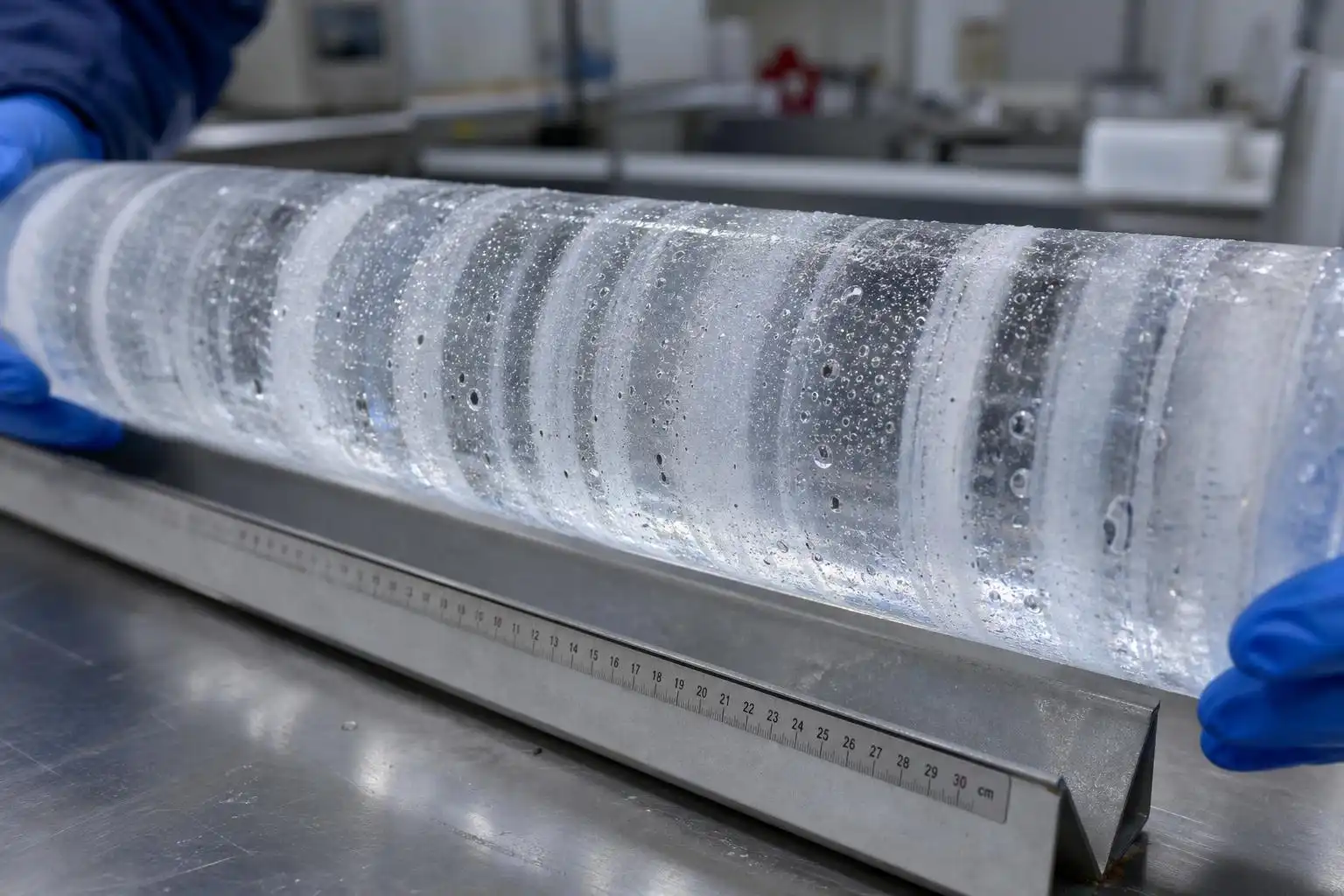
Ice cores work because snow that falls on polar ice sheets does not simply accumulate and compact into a featureless mass. It traps things. Tiny air bubbles form as the snow compresses into firn and then into glacial ice; when pores close off, they seal time-averaged samples of the ancient atmosphere — concentrations of CO₂, methane, and nitrous oxide — in air that is younger than the surrounding ice. Dust from distant deserts settles into annual layers. Volcanic ash from eruptions on the other side of the planet arrives as thin, dateable horizons. Even the ratio of oxygen isotopes in the ice itself shifts with temperature, because heavier water molecules (containing oxygen-18) evaporate less readily from the ocean surface during cold periods, leaving a chemical fingerprint of local to regional temperature and moisture-source history in every layer.
When we pull a core from the ice and hold it up to the light, we are holding a thermometer, a barometer, and an atmospheric chemistry lab all at once. The EPICA Dome C core, drilled by a European consortium and completed in 2004, gave us 3,270 metres of ice representing those 800,000 years. The deepest ice at the bottom of that core fell as snow before our species existed.
CO₂ and Temperature: A Relationship Written in Ice
One of the most important things the ice cores showed us — and this is not a modelling result, not a theoretical prediction, but a direct empirical measurement — is that atmospheric CO₂ and global temperature have moved together across every glacial cycle in the record. During ice ages, CO₂ hovered around 180 parts per million. During warm interglacials, it rose to roughly 280 ppm. The planet was, on average, about five to six degrees Celsius cooler during the coldest glacial maxima than during the warmest interglacials.
That relationship is not a coincidence. CO₂ is a greenhouse gas, and its concentration in the atmosphere amplifies the orbital forcing — the subtle wobbles in Earth’s path around the sun — that paces the ice ages. Without the CO₂ feedback, those orbital nudges would produce only modest temperature swings. With it, they tip the planet between worlds.
Today, atmospheric CO₂ is above 424 ppm. That number has not existed in this ice archive. It has not existed on Earth for at least three million years, and possibly longer. We have, in a geological instant, moved the atmospheric composition outside the envelope of the entire Pleistocene record. The ice cores do not tell us exactly what happens next, because they have never seen this before. But they tell us, with great clarity, how sensitively the climate system responds to CO₂ — and the answer is: very.
The Lessons of Interglacials
The warmest periods in the ice core record — the interglacials — are particularly instructive. Marine Isotope Stage 11, roughly 400,000 years ago, was unusually long and warm. Stage 5e, about 125,000 years ago (called the Last Interglacial or Eemian), saw global temperatures perhaps one to two degrees Celsius warmer than pre-industrial levels, sea levels five to nine metres higher than today, and hippopotami living in the Thames valley. The Greenland ice sheet was substantially reduced. Parts of West Antarctica may have partially collapsed.
The Eemian is worth dwelling on, because it represents a world only modestly warmer than our own — and yet the sea level implications were profound. We did not reach Eemian temperatures through a sudden injection of CO₂. It was driven primarily by orbital geometry, which allowed more summer sunlight to reach high northern latitudes. The warming was gradual by geological standards and still took centuries to millennia to fully express itself in sea level.
We are now warming the planet faster than any orbital forcing can account for, and we are doing it from a starting point that already has less polar ice than the pre-industrial world. The ice cores do not let us be complacent about the timescales involved. Ice sheets are slow, but they are not infinitely patient.
Abrupt Shifts: The Dansgaard-Oeschger Warning
Perhaps the most unsettling thing the ice cores reveal is that the climate system is not always a smooth, gradual responder. Buried in the Greenland ice cores are the signatures of Dansgaard-Oeschger events — abrupt warmings of ten to fifteen degrees Celsius over Greenland, occurring within decades, sometimes within years. These events, of which there are roughly 25 in the last glacial period, are tied to reorganisations of the Atlantic overturning circulation: the great conveyor belt of ocean heat that keeps northwestern Europe disproportionately warm.
The ice record shows that the Atlantic circulation can flip between states rapidly. It has done so repeatedly. It is not a theoretical fragility — it is an observed one, written in ice that I have held in my hands. Current observational data suggests the Atlantic Meridional Overturning Circulation (AMOC) is weakening. Whether it approaches a tipping point under continued warming is one of the most actively debated questions in climate science. The ice cores do not give us a threshold. But they tell us, emphatically, that such thresholds exist and that the system has crossed them before.
Deep Time as a Calibration Tool
There is a tendency in climate communication to treat the instrumental record — the last 150 or so years of thermometer measurements — as the primary evidence base. It is important, but it is also very short. It covers less than two-tenths of one percent of the ice core record. Drawing conclusions about long-term climate sensitivity from a century and a half of data is like trying to understand the character of a river from a single afternoon’s observation.
The ice cores provide part of the calibration that the instrumental record cannot. Together with other lines of evidence, including broader paleoclimate records, they help constrain climate sensitivity — the amount of warming expected from a doubling of CO₂ — to the IPCC’s assessed likely range of 2.5 to 4 degrees Celsius. They tell us that the planet’s carbon cycle has feedbacks that amplify initial forcings. They tell us that warm periods, once established, can persist for tens of thousands of years. And they tell us that the transitions between states, while slow on human timescales, are fast on geological ones.
What the Ice Cannot Tell Us
I want to be honest about the limits of the archive. Ice cores are exceptional, but they are not oracles. They cannot tell us precisely how fast the West Antarctic Ice Sheet will respond to a given level of warming. They cannot resolve the exact threshold at which AMOC reorganisation becomes likely. They cannot account for the speed of the current forcing, which has no analogue in the Pleistocene record.
What they can do — and what I believe they do powerfully — is anchor the debate in physical reality. When someone argues that climate sensitivity is low, or that CO₂ has little effect on temperature, or that the planet will simply adapt smoothly to whatever we do, the ice cores are the empirical refutation. Eight hundred thousand years of atmospheric chemistry and temperature, preserved in frozen bubbles, say otherwise.
The Weight of the Record
I have spent enough seasons on the ice to know that the drilling camps are not romantic places. They are cold, cramped, logistically brutal, and sometimes genuinely dangerous. The work is slow — a few metres of core per day, handled with the care of irreplaceable artefacts, because that is exactly what they are.
But every time a new section of core comes up and you hold it to the light and see the bubbles caught in the ice — each one a sealed sample of an ancient sky — the weight of what you are looking at is difficult to overstate. This is not a model. It is not a projection. It is the actual atmosphere of a world that no longer exists, preserved against all odds in a place where almost nothing survives.
The ice has been keeping this record patiently for nearly a million years. It does not care whether we read it carefully. But we should.



Leave a Reply