
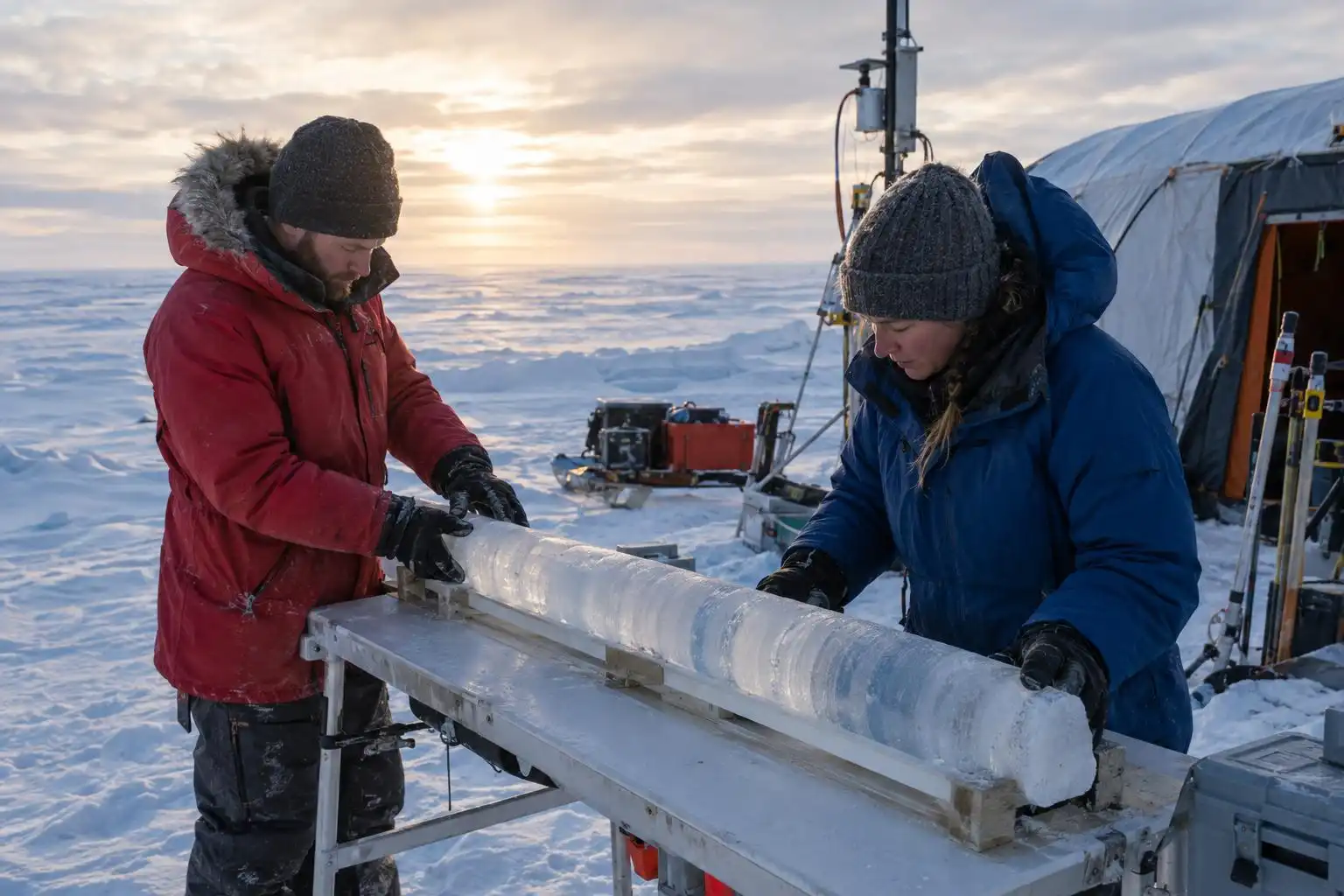

At a Greenland drilling camp, a length of ice can look almost empty: pale, clear, interrupted now and then by a thin band of dust. Yet its layers preserve the weather of years no one witnessed. About 8,200 years ago, those layers recorded a sharp turn toward colder conditions. The cold persisted for roughly 160 years before Greenland warmed again.
It is tempting to treat that episode as a preview of our future. It is more useful—and more honest—to ask what changed, how we know, and which parts of the comparison still hold.
A cold interval inside a warming world
The great ice sheets of the last glacial period were retreating. By 8,200 years ago, Earth was in the relatively warm Holocene, the interval in which agriculture and cities would develop. Then temperatures fell abruptly around the North Atlantic. In Greenland, ice-core evidence points to cooling of several degrees in some locations, far larger than an ordinary year-to-year fluctuation.
The signal was not identical everywhere. Other records indicate shifts in rainfall and temperature across parts of Europe, the tropics, and beyond, but they do not describe a single, uniform global freeze. That uneven geography matters: it helps identify the ocean circulation that may have carried the disturbance outward.
What the ice can actually tell us
Greenland’s snowfall traps clues to the air and water from which it formed. The proportions of oxygen isotopes in the ice change with climate, allowing us to trace the cold interval through successive layers. Where annual layers can be counted, they give the event a timeline with a precision rare in deep-time climate records.
An isotope shift is not a thermometer left running in the snow. It also reflects where moisture came from and when precipitation fell. Researchers therefore compare ice cores with other evidence, including marine sediments and cave deposits. Those records support a widespread disruption, while reminding us that a Greenland temperature estimate should not be mistaken for a global one.
The ice does something else important: it preserves the shape of the change. The onset was rapid compared with the roughly century-and-a-half duration of the event. A climate system can be pushed quickly, yet take much longer to settle back.
A lake large enough to trouble an ocean
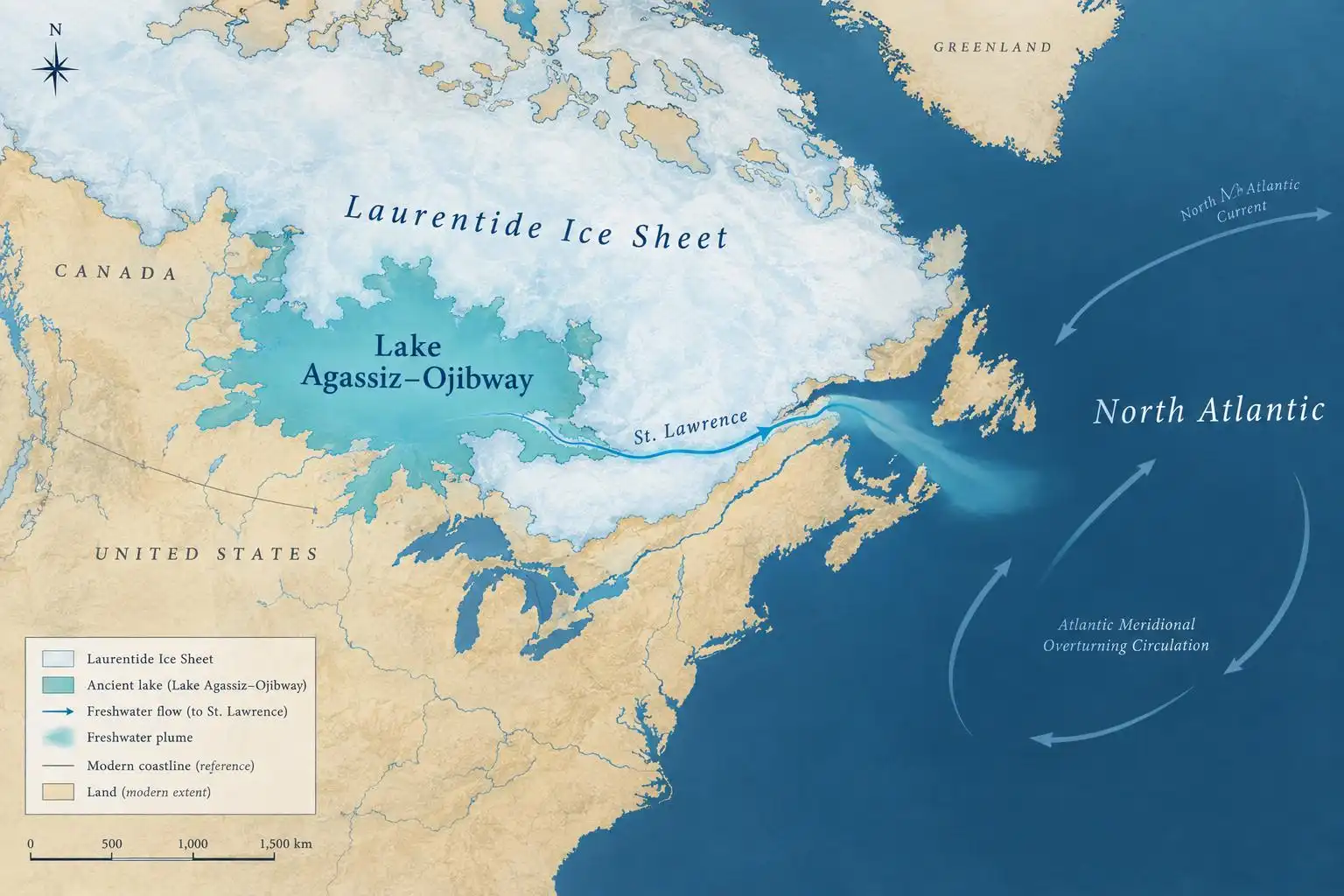
The leading explanation begins with glacial Lake Agassiz–Ojibway, an immense body of meltwater held near the remains of the North American ice sheet. As the ice barrier changed, a large volume of freshwater drained toward the North Atlantic. The exact routing and quantity remain subjects of research, but the broad sequence connects a freshwater release with the cold interval.
That water could have reduced the salinity of northern surface seas. Saltier, colder water is dense enough to sink in parts of the North Atlantic; freshening makes that sinking harder. The resulting disturbance to the Atlantic Meridional Overturning Circulation, or AMOC, would have altered how much heat the ocean carried northward.
Ocean sediments provide clues to changes in circulation, and climate models can test whether a freshwater pulse produces a pattern resembling the evidence. Neither gives us a direct measurement of the AMOC from 8,200 years ago. Taken together, though, the records make a stronger case than the Greenland ice could make alone.
Why this is not a forecast of modern collapse
Today’s warming is driven primarily by greenhouse gases, not by a glacial lake suddenly emptying. The North American ice sheet that impounded Agassiz–Ojibway is gone. We cannot simply copy the size or timing of the ancient freshwater pulse onto a map of today’s Atlantic.
There is nevertheless a relevant physical connection. Warming increases rainfall and runoff in some regions and melts Greenland ice, adding freshwater to northern seas. Climate models project that the AMOC will weaken during this century under continued warming. How much it will weaken—and whether it could cross a threshold into a much more abrupt change—remains uncertain. The IPCC’s Sixth Assessment assesses a weakening this century as very likely, while finding an abrupt collapse before 2100 unlikely, with medium confidence.
Those are different claims. Evidence that Atlantic circulation can be disturbed does not establish that collapse is imminent. Equally, uncertainty about an abrupt collapse is not reassurance that weakening would have no consequences. The circulation affects regional temperature, rainfall, and sea level; those effects deserve attention without an ancient catastrophe being presented as a countdown.
The lesson held in the layers
The 8,200-year event shows a climate system with connections that can transmit a disturbance far beyond its starting point. It also shows why context matters. Ice sheets, coastlines, background temperatures, and the source of the disturbance were different from ours.
When I look at a sharp turn in a core, I do not see a script for the next century. I see evidence that apparently steady conditions can depend on moving water and ice—and a reason to measure today’s changes carefully, while there is still time to choose how much warming we cause.


Leave a Reply
You must be logged in to post a comment.