


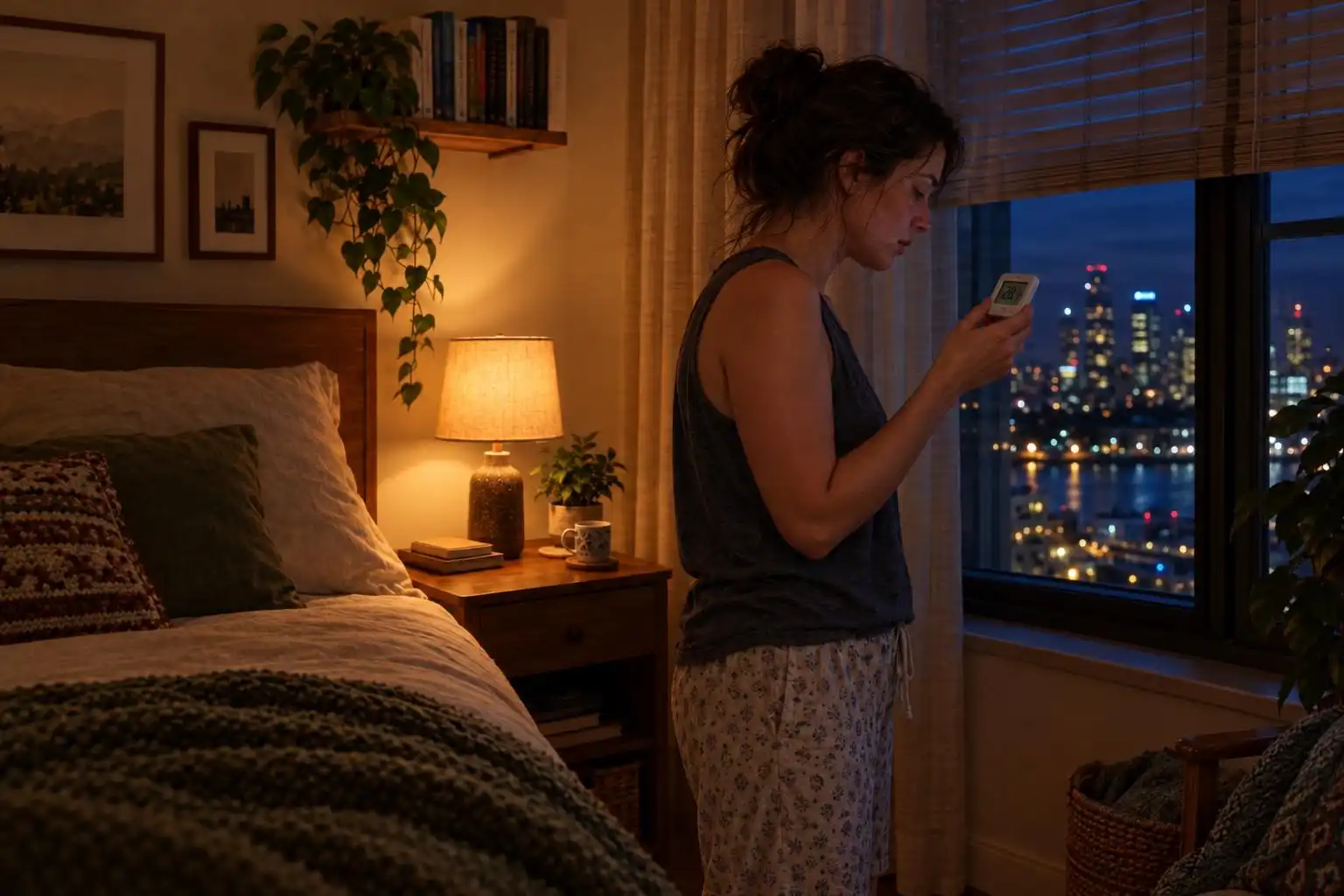
You check the forecast, see that tomorrow’s high is lower, and hope your apartment will finally cool down. But at midnight the walls still feel warm. The bedroom thermometer reads 85°F (29°C), and the air outside barely feels different. Is this just an uncomfortable night, or something you need to take seriously?
It can be both. A warm bedroom does not automatically mean a medical emergency, and there is no single indoor temperature that tells everyone whether they are safe. But heat that persists overnight gives your body less time to recover. The useful question is not only how hot tomorrow will be. It is whether you, in the place you actually sleep, can cool down tonight.
Why your apartment can stay hot after the forecast improves
A forecast high describes outdoor air at a particular time. It cannot tell you what happened all afternoon inside a top-floor room with a sun-facing window. Roofs, pavement, and walls absorb heat during the day and release it later. Apartments may also trap heat when windows do not open safely, air cannot move through the building, or an air conditioner cannot keep up.
Your neighborhood matters, too. The Environmental Protection Agency explains that built-up areas often remain warmer than surrounding places at night because surfaces hold heat and there is less vegetation to cool the air. Two people in the same city can therefore have different nights: one under a tree-lined street with a breeze, the other beside a broad stretch of asphalt.
Climate change adds to this problem by making heat extremes more frequent and intense in many regions. It does not mean every stuffy bedroom has a single, identifiable climate cause. Your building’s insulation, shade, ventilation, and cooling equipment still shape the temperature you experience. The broader trend matters because it can make the conditions that test those buildings more likely and, in some places, longer-lasting.
This is why a cooler-looking forecast is not always reassuring. If the outdoor low comes just before dawn and your room has stored heat all day, you may spend most of the night warmer than that low suggests. A small indoor thermometer, placed away from direct sunlight and appliances, can answer a more personal question than the weather app: is your sleeping space actually cooling?
What your body needs from a cooler night
Your body sheds heat through the skin, and sweat helps when it can evaporate. In humid air, evaporation works less well. A hot night can interrupt sleep and leave you starting the next day already warm and tired. If several hot days and nights follow one another, there may be little opportunity to recover between exposures.
The CDC’s heat guidance notes that heat illness can develop when the body cannot cool itself adequately. The danger is not confined to people exercising outside. Someone resting indoors can be at risk if the room stays hot, particularly when other health conditions or medications affect temperature regulation.
That does not mean you should stare at a thermometer waiting for a universal danger number. Humidity, air movement, time spent in the heat, and your health all matter. An 85°F bedroom will not feel or affect everyone the same way. What matters most is the pattern: a room that stays hot, nights that bring no relief, and a person who is beginning to feel unwell.
A fan may make a room feel more bearable and help sweat evaporate, especially if you can bring in cooler air. But it does not lower the air temperature. The CDC warns against relying on a fan as your main protection when indoor temperatures are above 90°F (32°C). If the room remains very hot, the safer plan is to find an air-conditioned place rather than expect the fan to solve it.
How do you know whether your nights are becoming risky?
Start with the information closest to you. Note the temperature in the room where you sleep in the evening and again when you wake. Check whether it falls overnight or stays nearly unchanged. You do not need an elaborate monitoring setup; a simple record over a few hot nights can show whether opening windows after sunset helps, or whether your apartment barely releases heat.
Then look beyond tomorrow’s high. Your local weather service’s heat alerts take account of dangerous conditions over time, while the National Weather Service’s HeatRisk tool offers a daily view of potential heat impacts. These are reasons to prepare, not guarantees that an unalerted bedroom is safe. Forecasts describe a wider area; they cannot see your top-floor apartment.
Your own circumstances change the calculation. Older adults, young children, pregnant people, and people with certain chronic illnesses face greater heat risks. Some medications can affect sweating, hydration, or blood pressure. If that might apply to you, ask a clinician or pharmacist for advice before a heat wave. Do not stop a prescribed medicine on the basis of a weather forecast.
Also ask a practical question: if you began to feel ill at 2 a.m., what could you do? A working air conditioner in another room, a nearby person you could call, or a safe way to reach a cooler place changes your options. If you live alone, have limited mobility, or rely on public transit, making that plan before the hottest night is more useful than trying to improvise while exhausted.
What can you do tonight if the bedroom will not cool?
If you have air conditioning, use it to cool the space where you spend time, and close blinds or curtains against daytime sun. You do not have to make the whole home chilly to benefit from a cooler room. If cost is the barrier, check whether your utility or local government offers bill assistance; the best immediate heat advice is not helpful if it ignores whether you can afford to follow it.
Without air conditioning, compare indoor and outdoor air before opening windows. Ventilation may help when it is cooler outside and safe to open them. When the outside air is hotter, closing windows and blocking direct sun can slow heat entering. A cool shower or damp cloth can help your body cool; drink water regularly, especially if you are sweating, unless a clinician has given you different fluid instructions.
Sometimes the realistic answer is to spend time elsewhere. A library, community center, shopping center, or designated cooling site may offer relief, though hours and accessibility vary. Check local government listings before you need them: a cooling center that closes at 6 p.m. does not solve a midnight problem. If you cannot sleep safely at home, consider whether a trusted friend or relative has a cooler place to stay.
Think about the people whose rooms you cannot see. A brief call to an older neighbor or family member can reveal that their air conditioner has failed or that they are reluctant to ask for help. Offer something specific, such as a ride to a cooler place or help finding its opening hours. This is not about assigning anyone a climate homework list. It is about making it easier to get through a difficult night.
If a power outage is possible, charge your phone and identify where you could go before the lights go out. Keep in mind that a public cooling site may not be open overnight, and a fan will not work without electricity. Knowing which friend, relative, or local service you can contact gives you a better fallback than waiting to see whether the room cools on its own.
When is it time to seek medical help?
Pay attention to how you or someone with you feels, not just the temperature display. Heavy sweating, headache, dizziness, nausea, weakness, and a fast pulse can be signs of heat exhaustion. Move the person to a cooler place, loosen clothing, and use cool water or wet cloths while seeking medical advice. If symptoms worsen or do not improve, get medical help promptly.
Confusion, fainting, or other signs of serious impairment may indicate heat stroke. That is an emergency: call emergency services immediately and begin cooling the person while help is on the way. The CDC’s guidance on heat-related illness is worth reading before a hot spell, when it is easier to take in the details.
Children and older adults may not describe symptoms clearly. If someone seems unusually disoriented or difficult to wake after time in the heat, do not wait for them to say they feel too hot. And if you are alone and beginning to feel faint or confused, calling for help early is a sensible decision, not an overreaction.
There is room between ignoring a hot room and treating every restless night as a catastrophe. A call for medical advice can help when symptoms concern you; emergency services are for signs of severe illness. You do not have to diagnose yourself perfectly before asking for help.
What is worth changing before the next hot spell?
Once the immediate heat has passed, your notes about indoor temperatures can help you decide what to change. A window shade may cut afternoon sun; a better-sealed air conditioner may cool one room more effectively. If you rent and a cooling system is broken, report it to the landlord and check local tenant rules. Your options depend on the building and where you live, so start with the problem you can document.
It is also reasonable to ask local officials about overnight cooling access, utility assistance, or heat alerts that reach people who do not use weather apps. These questions matter because staying safe should not depend entirely on being able to buy equipment or leave home at a moment’s notice. Your individual choices help, but they cannot substitute for housing and public services that work during heat.
For tonight, the clearest answer is this: take a bedroom that stays hot seriously, especially if it happens night after night or someone inside is vulnerable. Check the room, notice how you feel, and know where you could cool down. Climate change makes this a more pressing question, but you do not need to solve climate change before you are allowed to protect your sleep and your health.


Leave a Reply
You must be logged in to post a comment.