
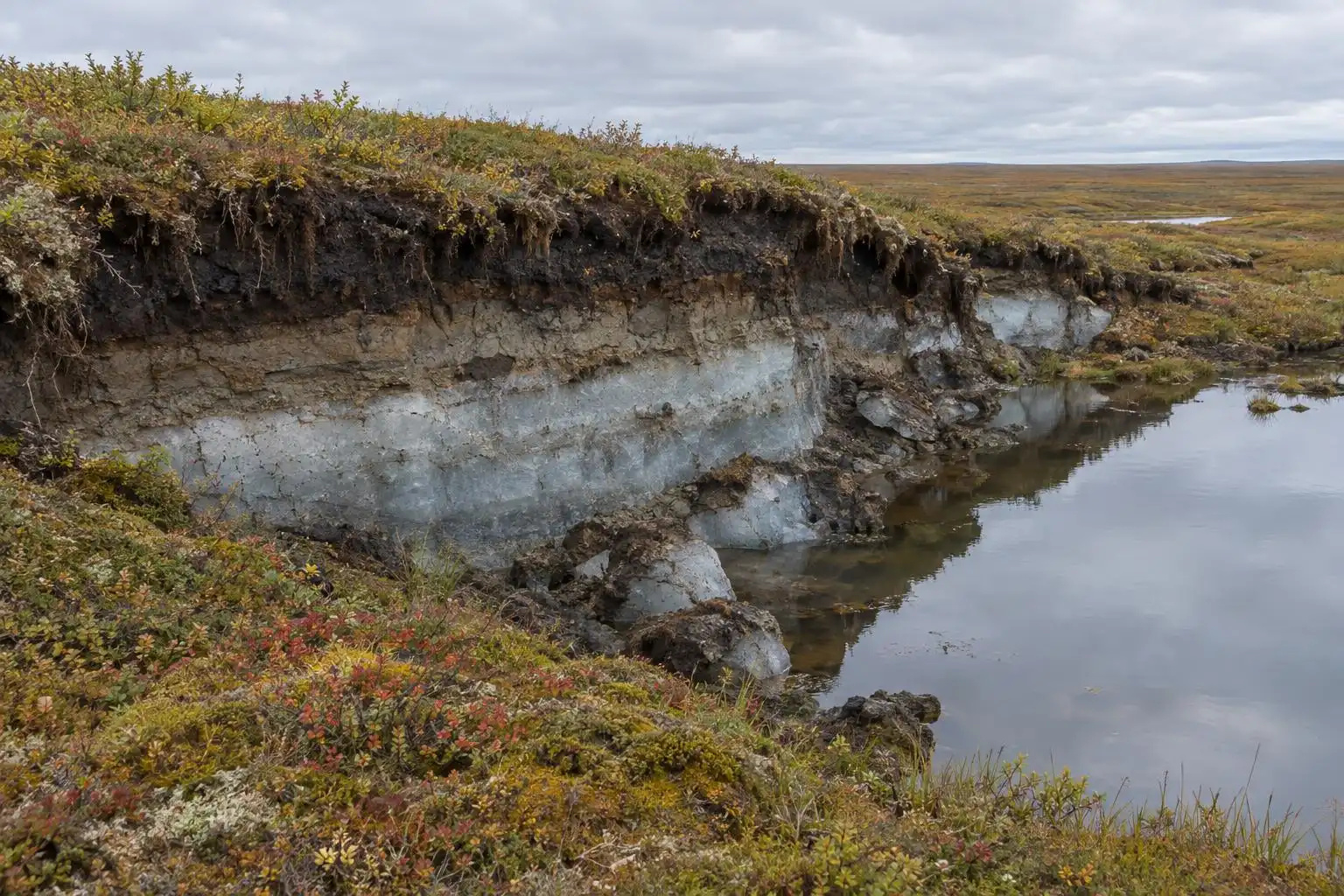

Permafrost holds an enormous amount of carbon, and a warming Arctic is putting some of it at risk. That is a serious climate problem. It is not, however, a single underground stockpile waiting to explode on a particular date. Describing it that way makes the story sound more certain—and less useful—than the science allows.
The question is not whether thaw can release greenhouse gases. It can. The questions are how much carbon will become available to microbes, how quickly they will process it, which gases will escape, and how those releases change the emissions cuts needed to limit warming.
Frozen ground, stored carbon
Permafrost is ground that remains at or below freezing for at least two consecutive years. Across northern permafrost regions, soils and deeper deposits contain roughly 1,300 to 1,600 billion tonnes of organic carbon. That is carbon, not carbon dioxide: multiplying by about 3.67 converts a tonne of carbon to the equivalent mass of CO2. Confusing the two units can make a large number look nearly four times larger.
Much of this carbon accumulated as plants grew, died and became buried in cold, often wet ground where decomposition was slow. Thaw does not instantly turn that stored material into emissions. Microbes must break it down, and their activity depends on temperature, moisture, oxygen and the kind of organic matter available. A newly thawed patch of soil is not an exhaust pipe.
Plants can also grow more vigorously as conditions warm, taking up some CO2. That uptake matters, but it does not justify treating a greener Arctic as a reliable offset. A plant may store carbon for a season or decades; carbon released from old soils can affect the climate for much longer.
Thaw changes the type and timing of emissions
When microbes decompose organic matter in oxygen-rich soil, they primarily produce CO2. In waterlogged, oxygen-poor conditions, they can produce methane. Methane is more powerful at trapping heat over the short term, though it remains in the atmosphere for far less time than CO2. A change in drainage can therefore change not only how much carbon escapes, but what form it takes.
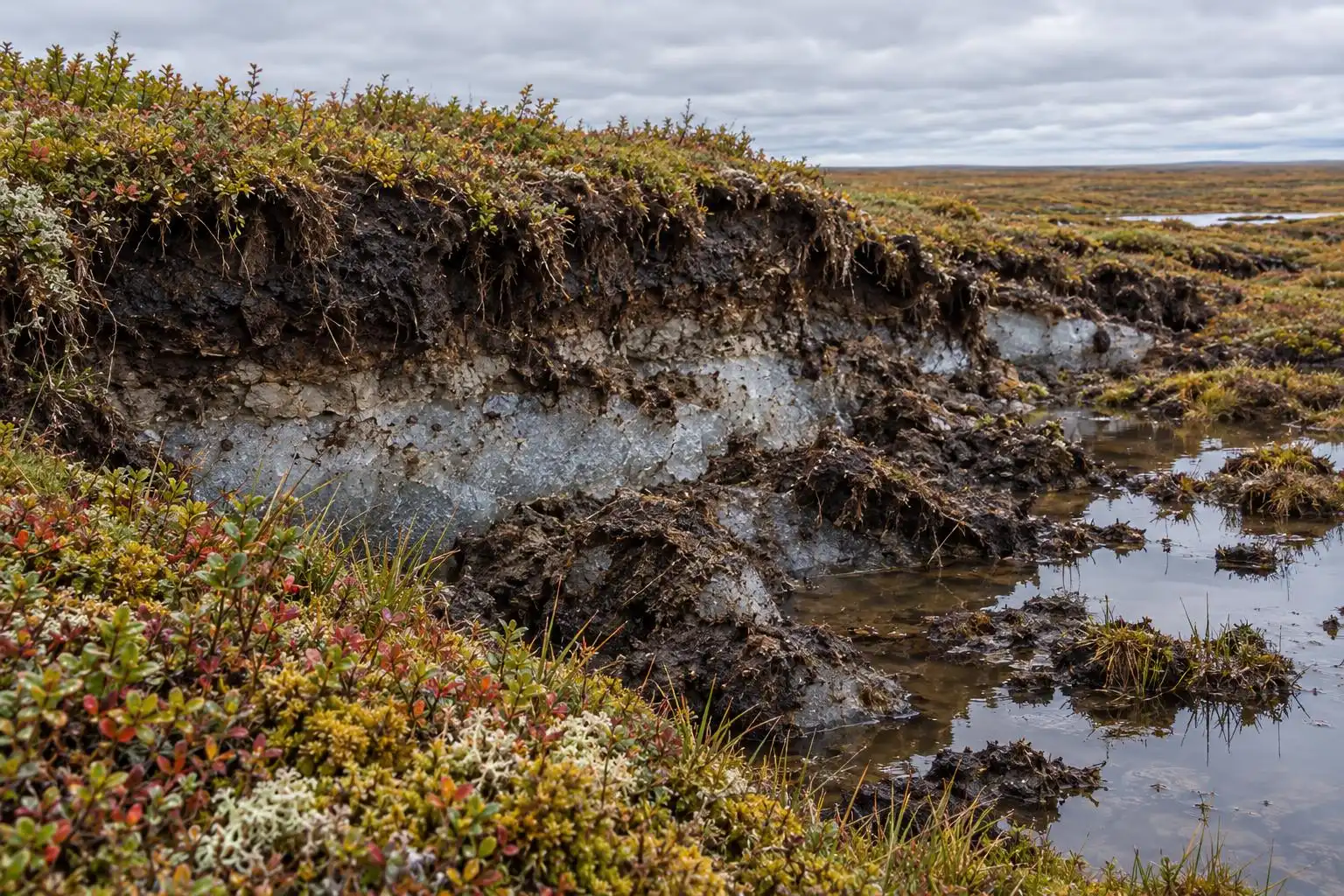
Thaw also takes different physical routes. Gradual warming deepens the seasonally thawed layer above permafrost. In places with ice-rich ground, melting ice can cause the surface to collapse, forming ponds or exposing buried material. These abrupt changes, often called thermokarst, can make carbon available faster than a smooth, gradual-thaw calculation would suggest. Wildfire can remove vegetation and insulating soil, leaving the ground more exposed to heat.
None of these processes occurs uniformly across the Arctic. A dry, well-drained hillside and a newly formed thaw pond have different emissions profiles. That variability is one reason a precise date for a supposed permafrost “tipping point” is not a sound basis for climate planning. It is also a reason not to assume gradual thaw captures the whole risk.
The carbon-budget problem is more precise than “runaway”
Permafrost emissions are a climate feedback: human-caused warming helps release greenhouse gases, which cause further warming. But feedback is not a synonym for an unstoppable chain reaction. How much warming occurs still depends strongly on the emissions choices people make. Less warming means less thaw pressure and, generally, less carbon at risk.
The practical issue is the remaining carbon budget—the amount of human-caused CO2 we can still emit while retaining a given chance of limiting warming. Some Earth-system responses are represented in the models used to estimate that budget, but others, including aspects of abrupt permafrost thaw, are incompletely captured. The IPCC’s Sixth Assessment Report warns that additional feedbacks can reduce the budget. “Not fully included” is a reason to be more cautious with the number, not a license to invent a precise correction.
There is an accounting trap here, too. Permafrost carbon should not simply be added, in full, to projected fossil-fuel emissions. Most of the frozen stock is not expected to enter the atmosphere this century, and some associated processes are already represented in climate projections. A useful estimate specifies the time period, warming pathway and gases counted—and checks what the underlying budget already includes.
What net-zero plans should take from this
A country or company cannot claim to have prevented permafrost emissions by buying a generic land credit. Avoided fossil-fuel emissions and carbon removed from the atmosphere are different entries in the ledger; uncertain future losses from thaw are not a spare credit in either column. They are a risk that makes overconfident promises less defensible.
For climate policy, the response is straightforward even if the exact feedback is uncertain: cut human-caused emissions rapidly, protect carbon-rich northern landscapes where possible, and improve measurements of changing soils and greenhouse-gas fluxes. Monitoring cannot substitute for emissions cuts. It can tell us whether the margin for error in a carbon budget is shrinking.
The permafrost story needs neither a countdown clock nor reassurance that everything will thaw slowly. Frozen carbon is a substantial, unevenly distributed climate liability. We cannot choose its exact release schedule. We can still influence the warming that sets much of that schedule in motion.


Leave a Reply
You must be logged in to post a comment.