
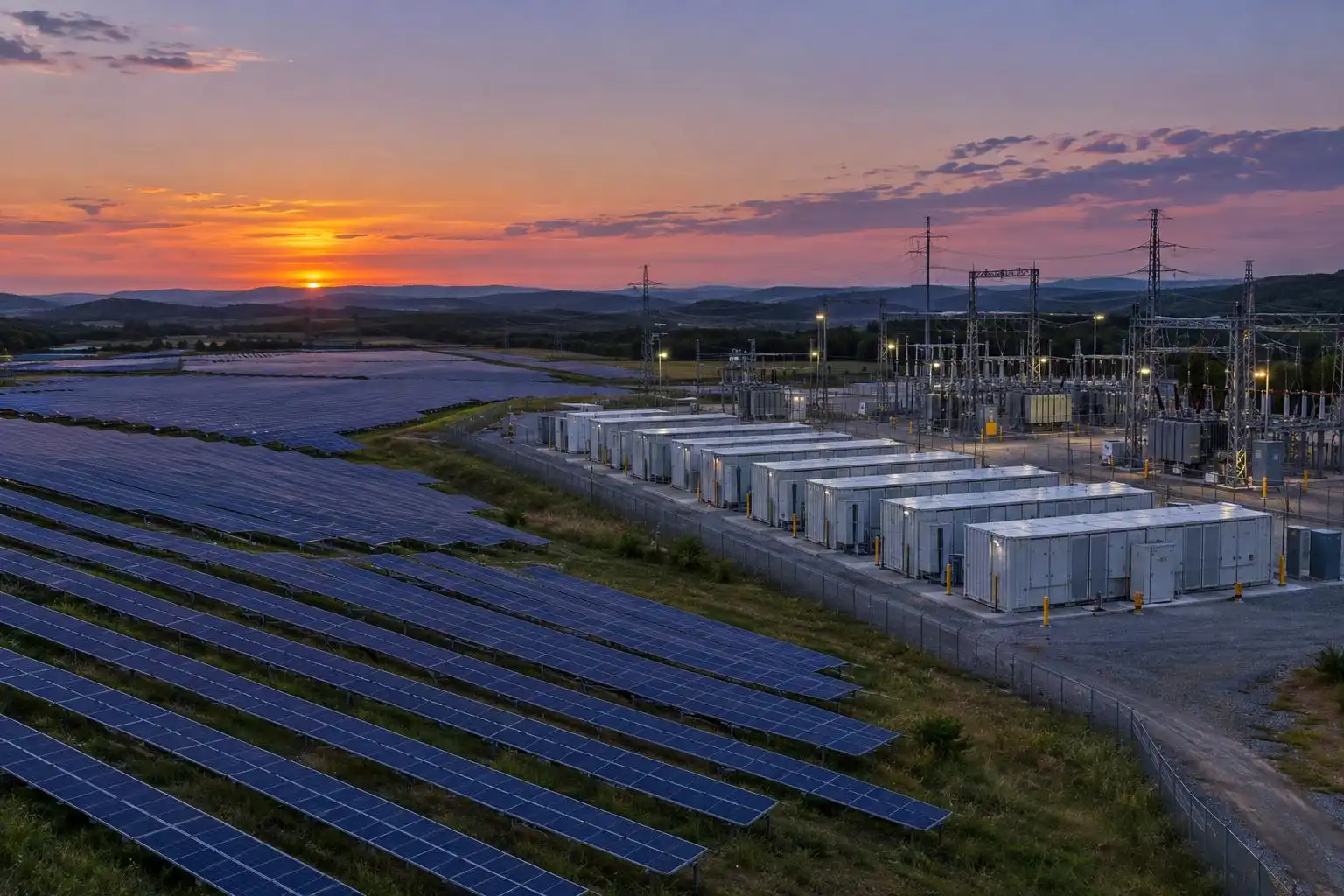

A battery beside a solar farm can move electricity from a sunny afternoon into the evening. That is valuable. But the climate result depends on what the battery charges from, when it discharges, and which generator responds. Installed capacity tells us what the equipment could do; dispatch tells us what it did.
That distinction matters more as storage deployment accelerates. BloombergNEF has raised its U.S. energy-storage deployment forecast by 30%, according to Utility Dive.[1] It is a consequential forecast revision, not a measured reduction in fossil-fuel generation.
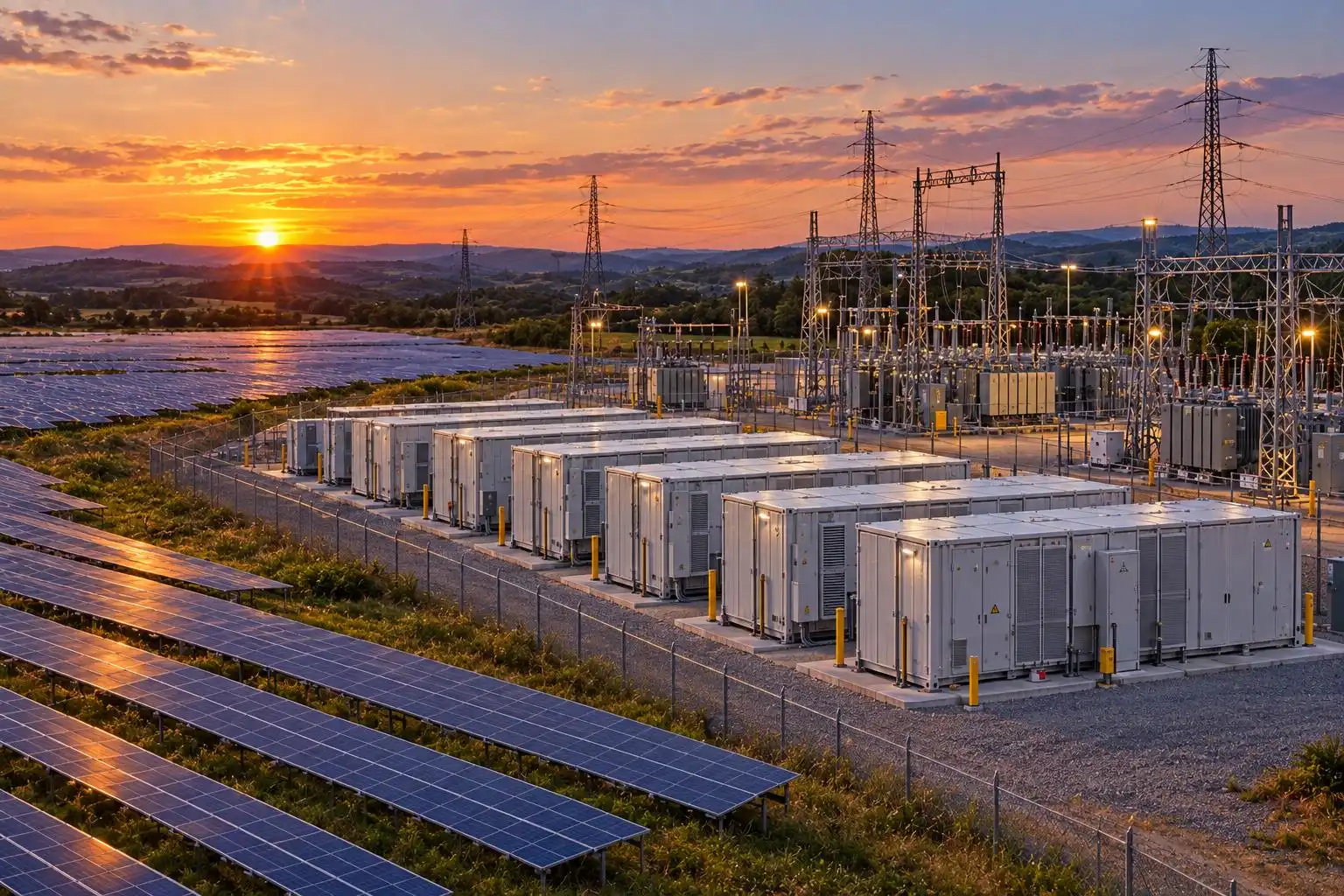
Solar and storage are increasingly built together
By the end of 2025, the United States had installed 20.7 gigawatts of storage, with 66.4 gigawatt-hours of energy capacity, alongside 41.3 gigawatts of solar, BloombergNEF figures reported by Utility Dive show. About 4 gigawatts of storage was colocated with solar in the first nine months of 2026.[1] The Energy Information Administration has likewise highlighted the increasing share of solar generation associated with colocated batteries.[2]
Those paired capacity figures describe equipment, not a fixed flow of electricity from solar panels into batteries. A colocated battery may charge from its neighboring array, from the grid if its configuration and rules permit, or from both. Its value also depends on interconnection rights: sharing a grid connection can make a project easier to develop, while limiting how much solar and storage can export at once.
Dividing 66.4 gigawatt-hours by 20.7 gigawatts gives roughly 3.2 hours of discharge at rated power. That is useful for shifting a portion of afternoon output into an evening peak. It does not make solar generation available through a long stretch of low sunlight, nor does it describe how many hours any particular project actually ran.
A bigger battery fleet is not automatically a cleaner grid
The global installed solar-to-storage capacity ratio has fallen from 94:1 in 2016 to 7:1 in 2026, BloombergNEF estimates. It expects the ratio to reach 4:1 in 2030.[1] Those are global capacity ratios, not U.S. operating results or a measure of emissions avoided.
Consider two batteries with identical nameplates. One charges on solar output that would otherwise have been curtailed and discharges when a gas plant would have ramped up. The other charges when fossil generation is on the margin and discharges into another fossil-heavy hour. Both shift energy; only the first has a clear path to substantial emissions savings. Because charging and discharging lose some energy, the second case can even increase generation requirements.
The practical test is hourly: compare charging and discharge with local demand, renewable output, curtailment, prices, imports, and the generation that changes at the margin. EIA’s real-time grid monitor is one starting point for regional operating conditions.[4] Regional charts alone, however, cannot establish the avoided emissions of a specific battery; that requires project dispatch data and a defensible counterfactual.
Data-center storage deserves its own accounting
BloombergNEF projects that cumulative storage serving data centers could reach 36 gigawatts and 66 gigawatt-hours by 2036, with much of that capacity in ERCOT, PJM, and MISO territory. It suggests PJM data centers may favor storage for load shifting over behind-the-meter gas generation because of tighter power-plant emissions restrictions.[1] This is a projection for a particular use of storage, not capacity already installed or necessarily paired with solar.
Here, too, the operating pattern matters. A data-center battery might reduce a facility’s draw during a grid peak, provide backup, or shift purchases to cheaper hours. None of those uses guarantees that the facility consumes less electricity overall. To assess its climate effect, ask when it recharges, whether it changes the center’s total load, and whether it replaces fossil backup generation or merely adds another energy-consuming asset.
Track delivered electricity, not just announced capacity
Storage is becoming a larger part of the energy system, and pairing it with solar can help make renewable output useful later in the day. The build-out is real. The unresolved question is how consistently these batteries reduce fossil generation in the hours when they operate.
For each new wave of projects, the useful scorecard is short:
- Capacity: How many gigawatts and gigawatt-hours are operating, rather than proposed?
- Dispatch: When do batteries charge and discharge, and how often?
- System effect: Which generation and emissions actually change?
The first number shows the pace of construction. The other two show whether that construction is delivering the cleaner grid promised alongside it.
References
- BNEF ups US energy storage deployment forecast by 30% | Utility Dive — https://www.utilitydive.com/news/bnef-ups-us-energy-storage-deployment-forecast-by-30/872870
- The share of solar generation with co-located battery storage is increasing – U.S. Energy Information Administration — https://www.eia.gov/todayinenergy/detail.php?id=68384
- Real-time Operating Grid – U.S. Energy Information Administration — https://www.eia.gov/electricity/gridmonitor


Leave a Reply
You must be logged in to post a comment.